Bernard 33 (B 33) and Surrounding Nebulae
Object
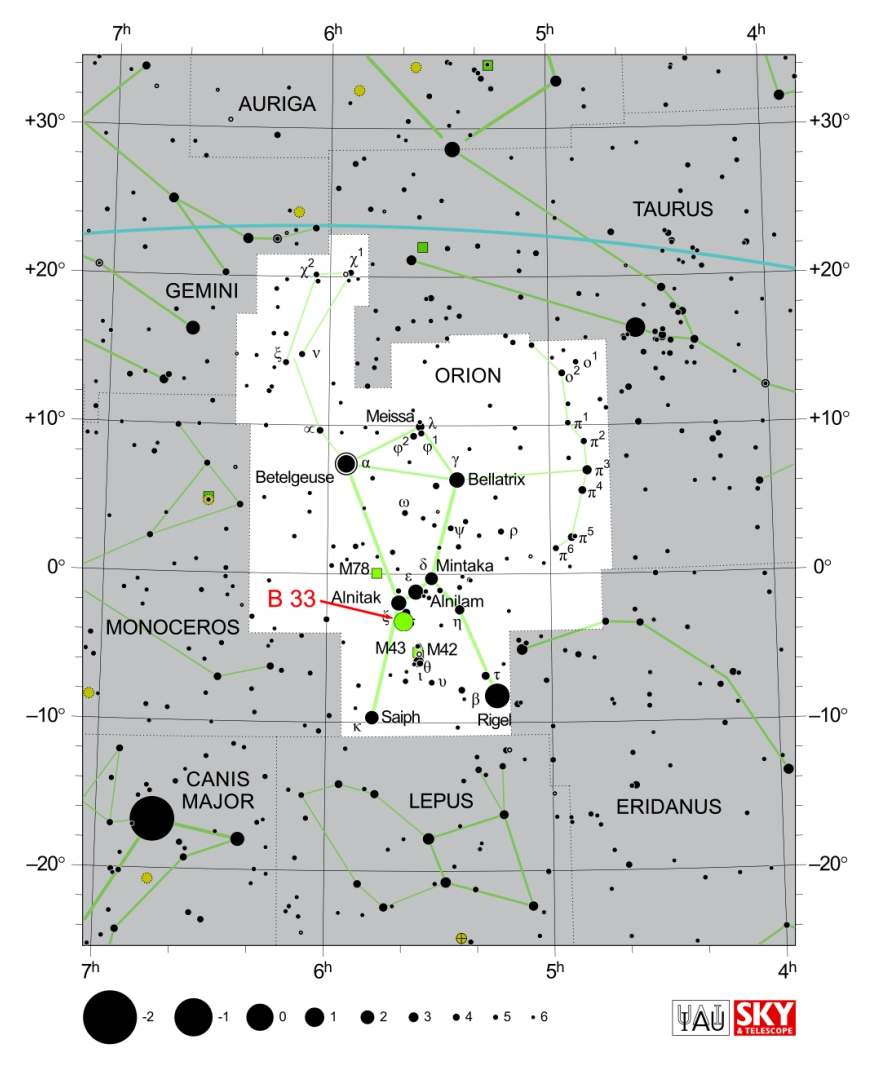
The Horsehead Nebula, catalogued as Barnard 33 (B33), is a dark nebula located in
the constellation of Orion approximately 1,375 light-
Dark nebulae are dense concentrations of gas and dust that obscure background radiation
through absorption and scattering processes. The Horsehead Nebula is particularly
significant because it presents a well-
Observations across optical, infrared, submillimeter, and radio wavelengths have
revealed a complex environment characterized by steep density gradients, intricate
chemical networks and strong radiative influences from nearby massive stars. The
nebula is widely studied in astrophysics because its geometry provides a relatively
simple and accessible example of a photon-
Image
Location: Cork city, Ireland (Bortle 7).
Date: 11th November 2025.
Seeing: Poor to average.
Moon Phase: Waning Gibbous, 53-
Telescope: William Optics GT 81 Mk IV.
Barlow/Reducer: Willaim Optics Flat 6AIII 0.8X Flattener/Reducer.
Coma Corrector: N/A.
Other Optics: N/A.
Camera: ZWO ASi 2600 MC Pro
Filter 1: Optolong L-
Filter 2: Optolong Clear (for capturing RGB stars).
Controller: ZWO ASiair Pro
Guide Scope: William Optics M-
Guide Camera: ZWO Asi 120MM Mini Guide Camera.
Guiding Error: 1.24” to 0.56” RMS.
Mount: Sky Watcher EQ6-
Image Processing:
Application 1: Graxpert.
Application 2: Pleiades Astrophoto PixInsight & Plugins.
Application 3: RC Astro BlurXTerminator.
Application 4: RC Astro StarXTerminator.
Application 5: RC Astro NoiseXTerminator.
Image Capture:
Light Frames: 35 x 180 s.
Flat Frames: 30.
Dark Frames: 30 x 180 s.
Bias Frames: 30.
The Physics
The famous “horse head” shape is not a glowing object itself. It’s a dark nebula
— a thick cloud of dust and molecular gas blocking light from the bright emission
nebula behind it, called IC 434. The nebula lies in the direction of the constellation
Orion, roughly 1,300–1,500 light-
molecular hydrogen (H2)
helium
carbon monoxide (CO)
silicate and carbon-
trace organic molecules
The dark appearance comes from dust absorbing and scattering visible light.
The Image
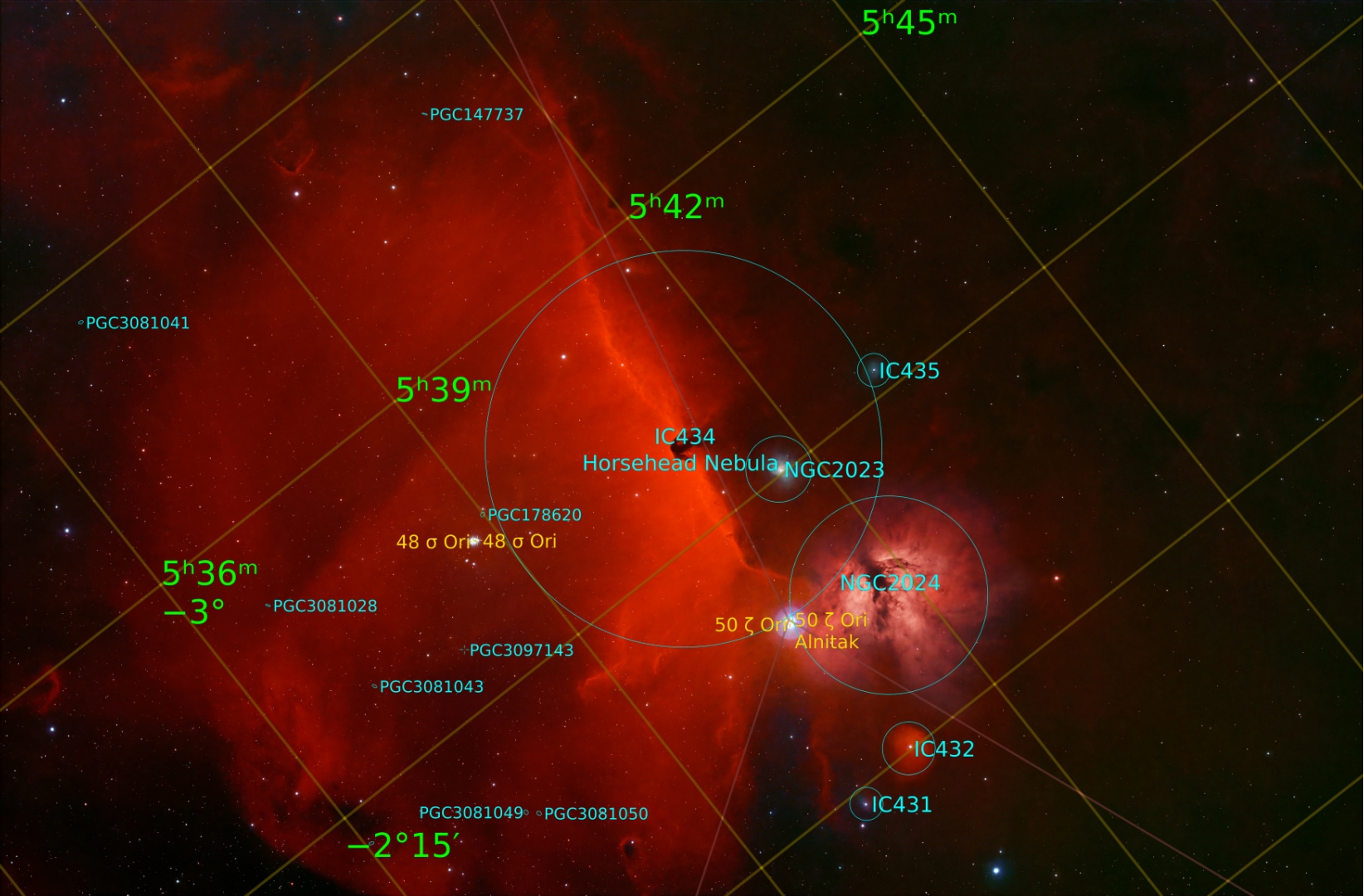
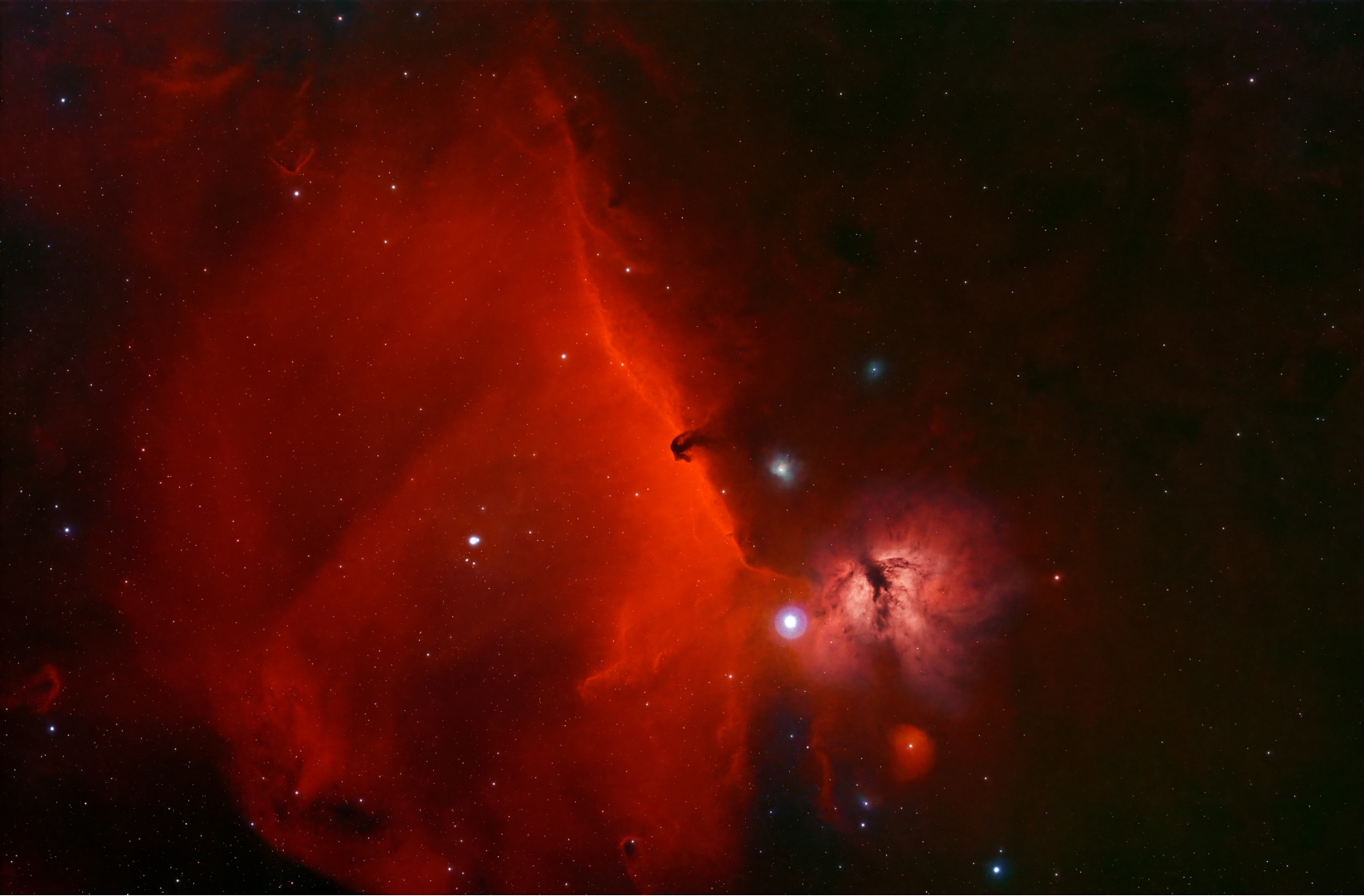
This image of B 33 (Horsehead Nebula) includes NGC 2023 and NGC 2024. The image was taken on the night of the 11th of November 2025. The image was captured with an OSC camera and processed primarily in PixInsight with plugins. The details are as follows:
Location: Cork city, Ireland.
Date: 11th November 2025.
Seeing: Poor to average.
Moon Phase: Waning Gibbous, 53-
Telescope: William Optics GT 81 Mk IV.
Barlow/Reducer: Willaim Optics Flat 6AIII 0.8X Flattener/Reducer.
Coma Corrector: N/A.
Other Optics: N/A.
Camera: ZWO ASi 2600 MC Pro
Filter 1: Optolong L-
Filter 2: Optolong Clear (for capturing RGB stars).
Controller: ZWO ASiair Pro
Guide Scope: William Optics M-
Guide Camera: ZWO Asi 120MM Mini Guide Camera.
Guiding Error: 1.24” to 0.56” RMS.
Mount: Sky Watcher EQ6-
Image Processing:
Application 1: Graxpert.
Application 2: Pleiades Astrophoto PixInsight & Plugins.
Application 3: RC Astro BlurXTerminator.
Application 4: RC Astro StarXTerminator.
Application 5: RC Astro NoiseXTerminator.
Image Capture:
Light Frames: 35 x 180 s.
Flat Frames: 30.
Dark Frames: 30 x 180 s.
Bias Frames: 30.
Location Annotated Image
History
The Horsehead Nebula, formally cataloged as Barnard 33 (B33), was first discovered on February 6, 1888, by Scottish astronomer Williamina Fleming. She spotted the distinct, dark silhouette on a photographic plate taken at the Harvard College Observatory during a stellar photography survey. While early visual astronomers found it incredibly difficult to see through traditional eyepieces, the advent of astrophotography revealed its true structure as a dense cloud of cold gas and dust blocking the bright light of the emission nebula IC 434 directly behind it. In 1919, American astronomer Edward Emerson Barnard officially included the celestial icon as entry number 33 in his catalog of dark nebulae, cementing its designation as Barnard 33. Today, the Horsehead Nebula remains one of the most photographed and heavily studied regions of star formation in the night sky, famously captured in breathtaking detail by modern space observatories like the Hubble, James Webb, and Euclid space telescopes.
Physics
The Horsehead Nebula is one of the most recognizable dark nebulae in the night sky
and serves as an important laboratory for studying interstellar medium physics, molecular
cloud chemistry, radiative transfer and star formation processes. Located within
the Orion Molecular Cloud Complex, the nebula is silhouetted against the bright emission
region IC 434 and exhibits a dense pillar-
Astronomical Context and Structure
The Horsehead Nebula resides within the Orion Molecular Cloud Complex, one of the
nearest massive star-
- The dense molecular cloud forming the Horsehead structure.
- The ionized hydrogen region IC 434.
- Nearby young stellar populations.
- Expanding ionization fronts produced by massive stars.
These interactions create a dynamic environment in which radiation pressure, photoevaporation and magnetic confinement collectively shape the nebula.
Morphology
The characteristic horsehead shape emerges from differential erosion of a dense molecular
pillar. Ultraviolet photons from nearby stars ionize lower-
- The dense “mane” region.
- The protruding nose-
like feature. - A narrow neck connecting the structure to the parent cloud.
- Surrounding ionized gas.
The nebula extends roughly 3.5 light-
Composition
The nebula primarily consists of molecular hydrogen (H2), which constitutes most of the mass of molecular clouds throughout the galaxy. Because cold molecular hydrogen emits weakly under typical cloud conditions, astronomers often trace it indirectly through carbon monoxide (CO) emission lines. Additional detected species include:
- Carbon monoxide (CO)
- Formaldehyde (H2CO)
- Ammonia (NH3)
- Methanol (CH3OH)
- Hydrocarbons
- Ionized carbon (C+)
- Neutral atomic carbon (C)
The rich molecular chemistry of the Horsehead Nebula has made it a benchmark object for astrochemical modelling.
Dust Physics
Interstellar dust plays a critical role in the appearance and thermodynamics of the nebula. Dust grains are composed primarily of silicates, carbonaceous material, and icy mantles. These grains absorb and scatter visible light, producing the nebula’s dark silhouette. Dust grains influence the cloud in several important ways:
- Shielding molecular gas from ultraviolet radiation.
- Catalyzing the formation of molecular hydrogen.
- Emitting thermal radiation in the infrared.
- Contributing to charge balance through photoelectric emission.
The extinction of starlight caused by dust is wavelength dependent, with shorter wavelengths being scattered more efficiently.
Radiative Process
The Horsehead Nebula is strongly affected by ultraviolet photons from nearby massive
stars, especially Sigma Orionis. High-
H + hv → H+ + e-
(Neutral hydrogen absorbs a photon and results in a hydrogen ion (a proton) and an ejected electron)
Where hv represents an energetic ultraviolet photon.
The ionized region reaches temperatures near 10,000 K, while the dense molecular cloud remains comparatively cold at temperatures of roughly 10–40 K.
A photon-
- Ultraviolet radiation dissociates molecules.
- Photoelectric heating from dust grains raises gas temperatures.
- Complex chemical reactions produce hydrocarbons and radicals.
- Radiative cooling occurs through atomic and molecular emission lines.
The balance between heating and cooling determines the local temperature structure.
Thermal Balance
Thermal energy equilibrium of the gas may be approximated by:
Г = Λ
Where Г is the total heating rate and Λ is the total cooling rate.
Heating mechanisms include photoelectric emission from dust and cosmic-
Dynamics of Fluid Physics
The Horsehead Nebula is not a static structure. Radiation-
Continuity Equation
dp/dt +▼. (ρv) = 0
Where ρ is mass density and v is velocity.
Momentum Equation
ρ ( dv/dt + v .▼v ) = -
Where P is pressure and g is gravitational acceleration.
Instabilities
Several hydrodynamic instabilities may influence the nebular morphology:
- Rayleigh–Taylor instabilities.
- Kelvin–Helmholtz instabilities.
- Thermal instabilities.
Such processes can fragment molecular gas and potentially trigger localized star formation.
Magnetic Fields
Magnetic fields are believed to contribute significantly to the stability and evolution of the Horsehead Nebula. Observations of polarized light suggest ordered magnetic structures aligned with portions of the cloud. Magnetic pressure can oppose gravitational collapse and influence gas flows. The magnetic pressure is given by:
Pb = B2 / 8π
Where Pb is magnetic pressure and B is magnetic field strength.
Magnetohydrodynamic effects help determine the shape and lifetime of the nebular pillar.
Chemistry of the Nebula
The Horsehead Nebula exhibits active molecular chemistry despite intense ultraviolet radiation. Molecular hydrogen forms primarily on the surfaces of dust grains through catalytic reactions. A simplified representation is:
H + H = H2
Hydrocarbon chemistry is especially rich in the PDR, where ultraviolet photons drive
reactions involving carbon-
- Ionized outer layer.
- Atomic transition zone.
- Dense molecular interior.
Different molecules dominate at different depths due to shielding effects and varying radiation intensity.
Star Formation Potential
Although the Horsehead Nebula itself is not a major star-
Mj = prop. (T3/ρ)½
Where Mj is the Jeans mass, T is temperature and ρ is density.
If a cloud core exceeds the Jeans mass, gravitational collapse may initiate star formation. Radiative compression from nearby massive stars may also induce triggered star formation by increasing local density.
Summary
The Horsehead Nebula is an example of the interaction between radiation, gravity, magnetism, and chemistry within the interstellar medium. Ultraviolet radiation from nearby massive stars sculpts the dense molecular cloud into its iconic shape through ionization and photoevaporative erosion. Within this environment, dust grains regulate thermal balance and molecular chemistry, while magnetic fields and fluid instabilities influence structural evolution.
The nebula’s sharp transition between ionized and molecular material makes it one
of the most important natural laboratories for studying photon-
Ultimately, the Horsehead Nebula represents more than a visually compelling astronomical object; it embodies fundamental physical processes operating throughout galaxies and provides insight into how stars and planetary systems emerge from cold molecular matter.
References
Tielens, A. G. G. M. The Physics and Chemistry of the Interstellar Medium. Cambridge University Press.
Draine, B. T. Physics of the Interstellar and Intergalactic Medium. Princeton University Press.
Hollenbach, D., & Tielens, A. G. G. M. Photon-
Abergel, A. et al. Observational studies of the Horsehead Nebula.
Pound, M. W., et al. Molecular structure and chemistry of Barnard 33.
Bally, J. The Orion Complex: A Laboratory for Star Formation.
Osterbrock, D. E., & Ferland, G. J. Astrophysics of Gaseous Nebulae and Active Galactic Nuclei.
Resources
Toward a robust physical and chemical characterization of heterogeneous lines of sight: The case of the Horsehead nebula. Segal et al. Astronomy and Astrophysics, Volume 692. December 2024.
Abstract: Context. Dense and cold molecular cores and filaments are surrounded by
an envelope of translucent gas. Some of the low-
Magnetic fields in the Horsehead Nebula. Hwang et al. Cornell University, March 2023
Abstract: We present the first polarized dust emission measurements of the Horsehead
Nebula, obtained using the POL-
Observations of the Bright Rim of the Horsehead Nebula in Ha and [NII]
An old but worthwhile paper.