Home News Astronomy Blog Astrophotography Links & Resources

Post-AGB Evolution and White Dwarfs

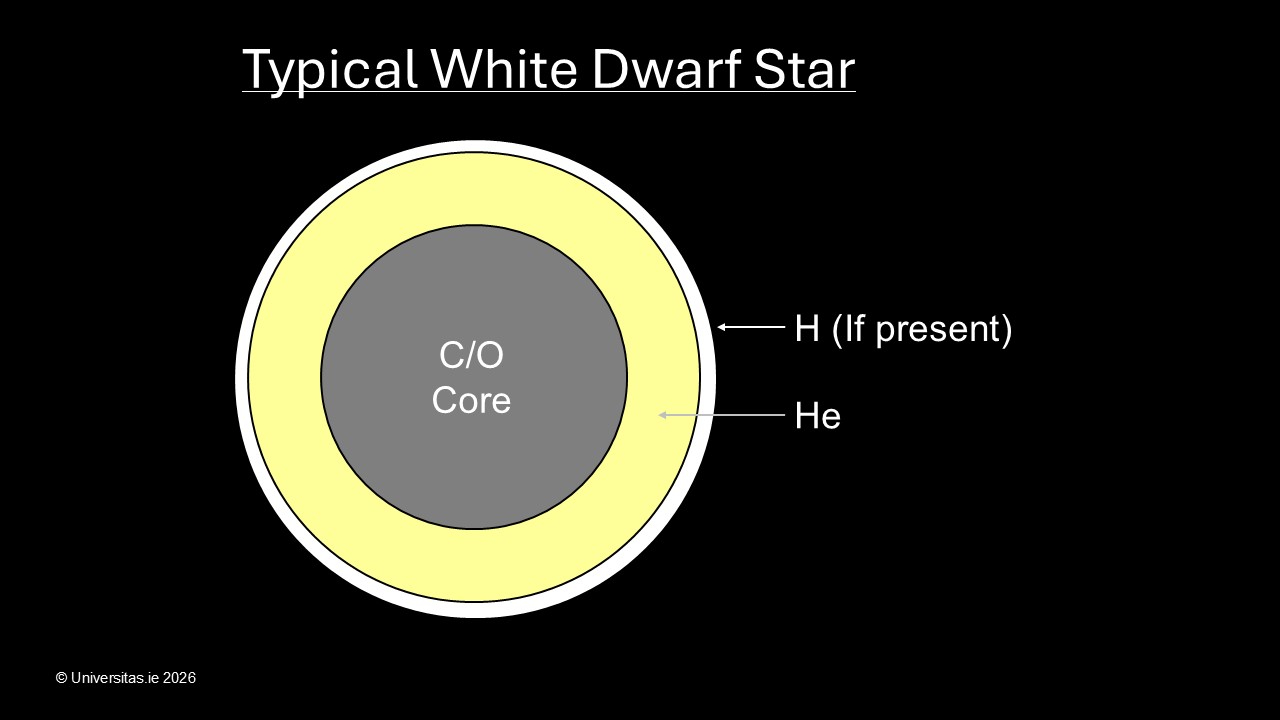
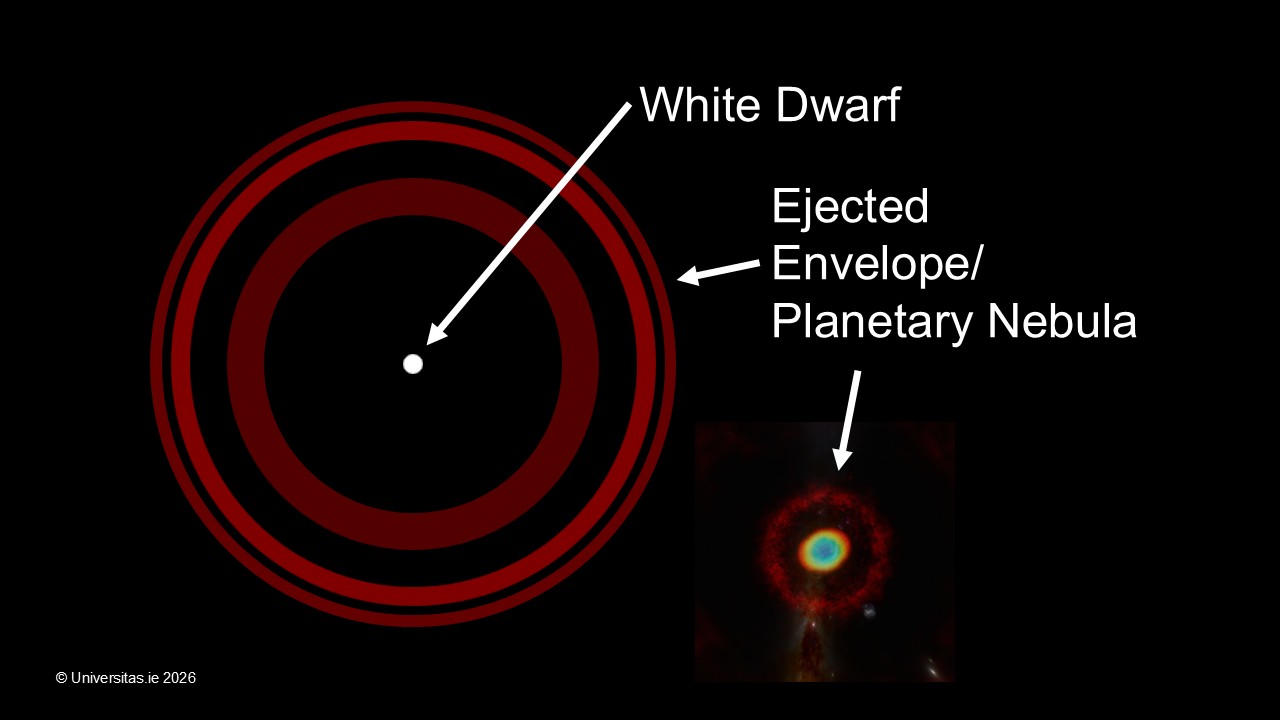
Low- to intermediate-mass stars eventually reach the tip of the AGB, where shell hydrogen and helium burning cease. Lacking sufficient mass to ignite carbon fusion, the star undergoes rapid contraction. During the post-AGB phase, intense mass loss in the form of a superwind ejects the stellar envelope, producing a planetary nebula surrounding a very hot central star. The exposed core then cools and evolves into a carbon–oxygen white dwarf.


The expelled envelope is enriched in heavy elements synthesized during stellar evolution and may be carbon- or oxygen-rich, depending on the star’s dredge-up history. As this material expands and cools, molecules and dust grains form, creating a circumstellar envelope in which strong infrared radiation can drive maser emission.


In rare cases, late or very late thermal pulses occur after the star has left the AGB, producing born-again AGB stars. These events can generate hydrogen-deficient post-AGB objects and are associated with unusual stellar populations, including variable planetary nebula nuclei, R Coronae Borealis stars, and some extreme horizontal-branch or subdwarf B stars.


White dwarfs represent the final evolutionary stage of low- to intermediate-mass stars (≲ 8 solar masses). On the H–R diagram, newly formed white dwarfs appear in the lower-left region, characterized by high surface temperatures and low luminosities. With no internal energy source, they cool by radiating away residual thermal energy, moving downward and to the right along the white dwarf cooling sequence over billions to trillions of years.


During early cooling stages, energy loss is dominated by photon radiation, while at later stages neutrino emission and crystallization of the degenerate core contribute significantly. As crystallization proceeds, latent heat is released, temporarily slowing the cooling rate. Ultimately, a white dwarf becomes a cold, dark remnant known as a black dwarf, although the Universe is not yet old enough for any to exist.


Large Mass Stars:

In massive stars, the core mass at the onset of hydrogen-shell burning is sufficiently large that helium fusion ignites under non-degenerate conditions. As a result, helium ignition occurs smoothly rather than via a helium flash. When these stars evolve off the main sequence and expand, they do not experience the dramatic, flash-driven luminosity increase characteristic of low-mass stars. However, because they are already highly luminous on the main sequence, they evolve into very luminous supergiants. As nuclear burning proceeds, increasingly massive cores are produced that cannot be supported by electron degeneracy pressure. The ultimate outcome is core collapse, leading to the formation of either a neutron star or a black hole.


Very massive stars, particularly at approximately solar metallicity and with initial masses above roughly 40 solar masses are sufficiently luminous that radiation-driven stellar winds cause rapid mass loss. These winds may remove much of the stellar envelope before the star can evolve into a red supergiant, allowing such stars to remain hot and blue throughout much of their post-main-sequence evolution. The maximum initial masses of stars in the present universe are estimated to be of order 100–150 solar masses (and possibly higher), as stronger radiation pressure would otherwise expel the outer layers. Lower-mass stars may also avoid becoming red giants or red supergiants if envelope removal occurs through binary interaction or if rapid rotation leads to efficient internal mixing, preventing the development of a distinct core–envelope structure.


The core of a massive star, defined as the hydrogen-depleted region, grows hotter and denser as material is added by hydrogen-shell fusion. In sufficiently massive stars, core temperatures and densities become high enough to allow fusion of carbon and heavier elements via alpha-capture reactions. Following helium burning, the core consists primarily of carbon and oxygen. In stars with initial masses of roughly 8–9 solar masses or greater, carbon ignition occurs, producing elements such as neon, sodium, and magnesium. Stars of slightly lower mass may ignite carbon only partially under degenerate conditions, leading to the formation of an oxygen–neon–magnesium core that may ultimately become a white dwarf if further core growth is prevented.

The precise mass threshold for complete carbon burning depends on factors including metallicity, rotation, and mass loss, but lies approximately in the range of 7–10 solar masses After carbon burning is completed, the core mass grows to roughly 2–3 solar masses and reaches temperatures sufficient for further nuclear burning. Neon burning follows as temperatures rise, and in stars with initial masses of approximately 8–12 solar masses, electron capture on neon and magnesium can destabilize the core, potentially leading to an electron-capture supernova.


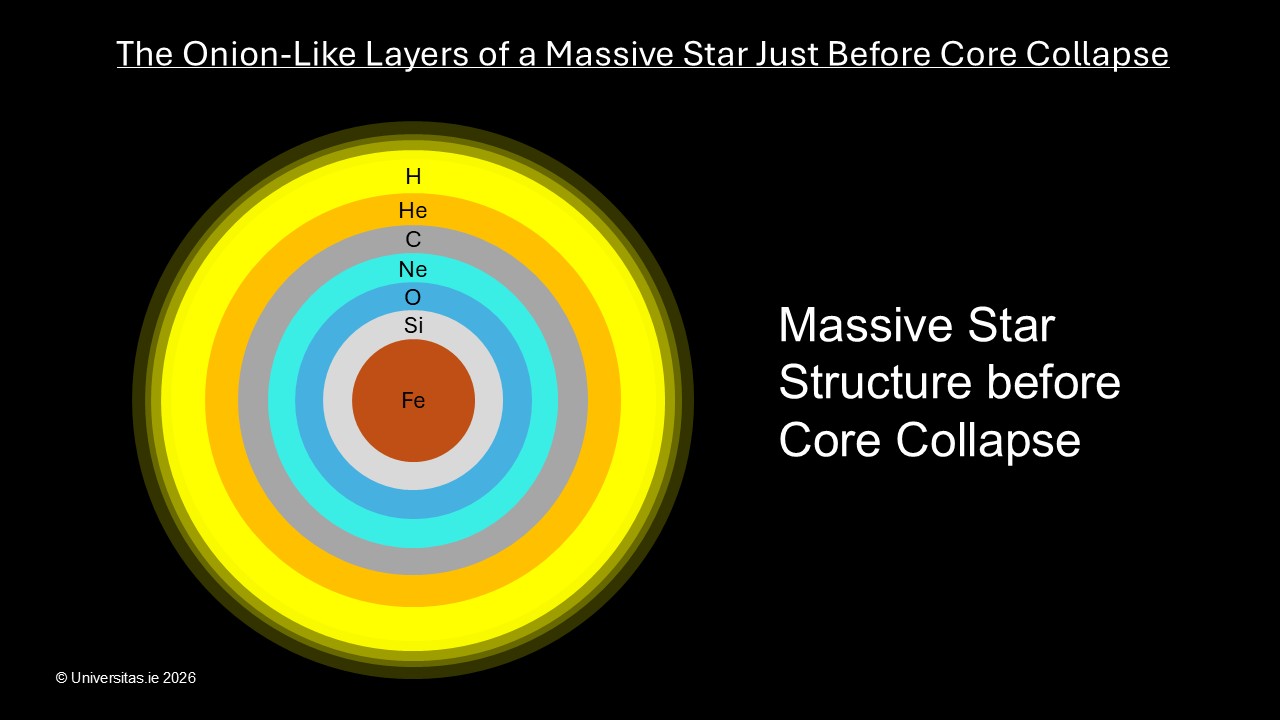
In more massive stars, neon burning proceeds stably, followed by oxygen and silicon burning. These processes produce an iron-group core surrounded by shells of lighter elements still undergoing fusion. The advanced burning stages proceed rapidly, with the final phases lasting from years to days, so the star’s external appearance changes little during this time. The iron core grows until it reaches an effective Chandrasekhar mass, which exceeds the classical Chandrasekhar limit due to relativistic effects, entropy, composition, and pressure from the surrounding layers. This effective limit ranges from approximately 1.3 solar masses in lower-mass red supergiants to over 1.8 solar masses in more massive stars. Once this mass is exceeded, electron capture reduces pressure support, the core collapses, and the star undergoes a core-collapse supernova or direct collapse to a black hole.


Supernovas

The collapse of the core of a massive star results in the formation of a neutron star or, if the core mass exceeds the Tolman–Oppenheimer–Volkoff limit, a black hole. During this collapse, a large fraction of the gravitational potential energy is released, primarily in the form of neutrinos. Through mechanisms that remain incompletely understood, a portion of this energy is transferred to the surrounding stellar material, giving rise to a Type II, Type Ib, or Type Ic supernova.


The core-collapse event generates an intense neutrino flux. These high-energy neutrinos deposit energy in the surrounding matter, dissociate nuclei, and liberate free nucleons, including neutrons, while also contributing thermal and kinetic energy that enhances the outward-propagating shock initiated by core bounce. Additional neutrons are produced through electron capture in the extremely dense infalling material. Neutron bombardment of the rebounding ejecta enables rapid neutron-capture nucleosynthesis, producing elements heavier than iron, including radioactive species extending to and beyond uranium.


While red giant stars can synthesize heavy elements via neutron-capture reactions occurring during earlier evolutionary stages, the resulting isotopic abundance patterns differ significantly from those produced in supernovae. Neither source alone reproduces the Solar System abundance distribution. Instead, the observed heavy-element abundances require contributions from multiple sites, including core-collapse supernovae, neutron-star mergers, and mass loss from evolved stars.


The energy transferred from the collapsing core not only drives nucleosynthesis but also accelerates the newly synthesized material beyond the stellar escape velocity, producing the observed supernova explosion. Despite substantial progress, current numerical models of Type II, Ib, and Ic supernovae do not yet account for sufficient energy transfer to fully reproduce observed explosion energies. Neutrino oscillations may play an important role in this process by redistributing energy among neutrino flavors and through additional general-relativistic effects.


Observational evidence from the masses and orbital parameters of binary neutron-star systems suggests that the collapse of oxygen–neon–magnesium cores may produce supernovae that are observably distinct from those resulting from iron-core collapse. In contrast, the most massive stars may undergo pair-instability supernovae, in which the explosion energy exceeds the gravitational binding energy of the star, leaving no compact remnant. In the early universe, even more massive stars likely collapsed directly into black holes following photodisintegration at the end of their nuclear burning stages.


For a star of 1 solar mass, the resulting white dwarf is of about 0.6 solar mass, compressed into approximately the volume of the Earth. White dwarfs are stable because the inward pull of gravity is balanced by the degeneracy pressure of the star's electrons, a consequence of the Pauli exclusion principle. Electron degeneracy pressure provides a rather soft limit against further compression; therefore, for a given chemical composition, white dwarfs of higher mass have a smaller volume. With no fuel left to burn, the star radiates its remaining heat into space for billions of years.


White and Black Dwarfs

A newly formed white dwarf is characterized by extremely high temperatures, with surface temperatures exceeding 100,000 K and substantially higher temperatures in its interior. During the first  years of its evolution, a significant fraction of its energy is lost through neutrino emission. Over timescales of order  years, the white dwarf radiates away most of its residual thermal energy and undergoes long-term cooling.


The composition of a white dwarf is determined primarily by the initial mass of its progenitor star. Progenitors with initial masses of approximately 8-12 solar masses may ignite carbon fusion, producing magnesium, neon, and smaller quantities of heavier nuclei. Provided that sufficient mass is lost to reduce the core below the Chandrasekhar limit and that carbon ignition does not proceed explosively, the remnant is an oxygen–neon–magnesium white dwarf. Stars with initial masses comparable to that of the Sun do not ignite carbon fusion and form white dwarfs composed predominantly of carbon and oxygen, with masses well below the collapse threshold. Stars with initial masses below roughly 0.5 solar masses are unable to ignite helium fusion and ultimately produce helium white dwarfs.


As cooling continues, white dwarfs asymptotically approach a cold, non-luminous end state commonly referred to as a black dwarf; however, the finite age of the universe precludes the existence of such objects at present.


If the mass of a white dwarf exceeds the Chandrasekhar limit, approximately 1.4 solar masses for compositions dominated by carbon, oxygen, neon, and/or magnesium, electron degeneracy pressure can no longer support the star as electron capture reduces the number of pressure-supporting electrons. The ensuing collapse leads to different outcomes depending on the core composition and central temperature. Heavier-element compositions favor continued collapse, as they require higher temperatures for thermonuclear ignition and permit more efficient electron capture, potentially resulting in the formation of a neutron star. Conversely, sufficiently high central temperatures favor runaway carbon and oxygen fusion, which halts collapse and produces a Type Ia supernova. Although Type Ia supernovae can reach peak luminosities exceeding those of core-collapse (Type II) supernovae, their total energy release is smaller.


The Chandrasekhar instability implies that stable white dwarfs cannot exist above approximately 1.4 solar masses, with possible minor exceptions for rapidly rotating white dwarfs in which centrifugal support partially offsets gravity. In binary systems, mass transfer from a companion star can drive an initially stable white dwarf beyond this limit.

In close binary systems where a white dwarf accretes hydrogen-rich material from a companion but remains below the Chandrasekhar limit, the accreted hydrogen layer may undergo a thermonuclear runaway on the surface, producing a nova eruption that ejects the accreted material without disrupting the white dwarf.

Neutron Stats and Black Holes.

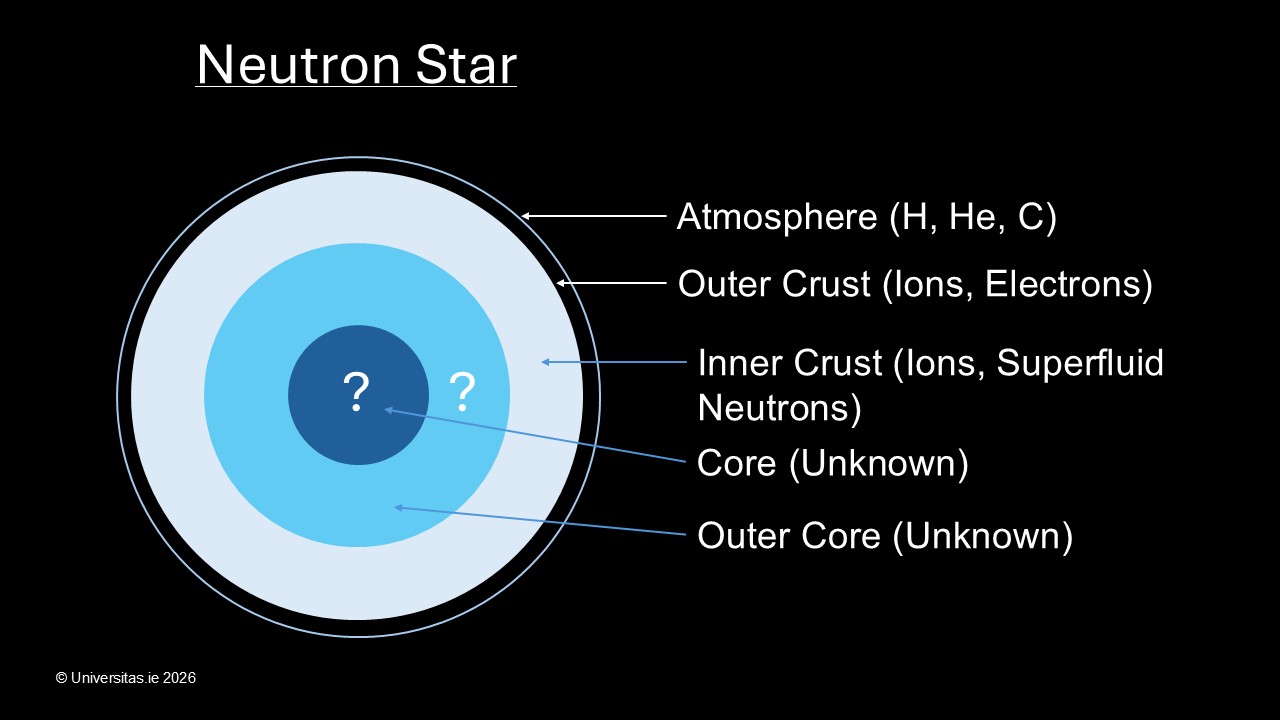
During the collapse of a massive stellar core, increasing density and pressure drive electron capture reactions in which electrons combine with protons to form neutrons and neutrinos. The resulting loss of electron degeneracy pressure allows the core to contract into an extremely dense state dominated by neutron-rich matter. If the mass of the remnant is sufficiently low, further collapse is halted by neutron degeneracy pressure arising from the Pauli exclusion principle, leading to the formation of a neutron star. This pressure is conceptually analogous to electron degeneracy pressure but is significantly stronger and depends on the poorly constrained equation of state of ultra-dense nuclear matter.


Neutron stars are highly compact objects with typical radii of order 10 km and mean densities comparable to or exceeding nuclear density. Conservation of angular momentum during collapse leads to rapid rotation, with observed spin periods ranging from milliseconds to several seconds. Neutron stars also possess intense magnetic fields. When the magnetic axis is misaligned with the rotation axis, collimated beams of electromagnetic radiation are produced; if these beams intersect the Earth, periodic pulses are observed at the stellar rotation period. Neutron stars exhibiting such pulsed emission are classified as pulsars. Although pulsar emission is most commonly detected at radio wavelengths, pulsars have been observed across the electromagnetic spectrum, including optical, X-ray, and gamma-ray bands.


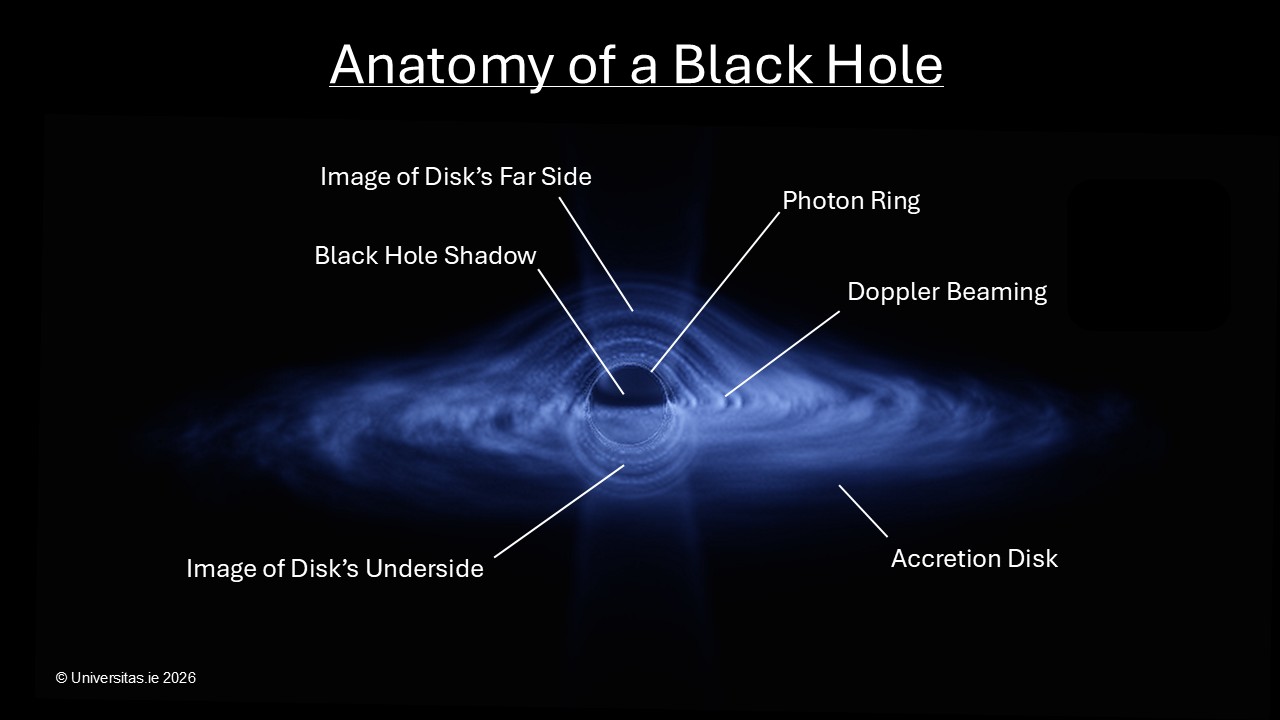
If the mass of the collapsing remnant exceeds the maximum mass supportable by neutron degeneracy pressure, continued gravitational collapse is unavoidable. In this case, the remnant contracts beyond its Schwarzschild radius and forms a black hole. The precise value of the maximum neutron-star mass remains uncertain owing to uncertainties in the equation of state of dense nuclear matter, but current theoretical and observational constraints place it in the range of approximately 2-3 solar masses.


Black holes are a direct prediction of general relativity. In classical general relativity, the event horizon constitutes a causal boundary from which neither matter nor information can escape to an external observer, although quantum-mechanical considerations may permit deviations from this behaviour. The existence of black holes is strongly supported by both theoretical arguments and extensive astronomical evidence, including electromagnetic observations and gravitational-wave detections.


Despite substantial progress, the detailed mechanisms linking stellar core collapse to the formation of neutron stars or black holes remain incompletely understood. It is not yet established whether some massive stars collapse directly into black holes without producing an observable supernova, or whether certain supernovae initially form unstable or metastable neutron stars that subsequently collapse into black holes. The relationship between the initial mass and composition of a star and the nature of its final compact remnant therefore remains an active area of research.


Summary

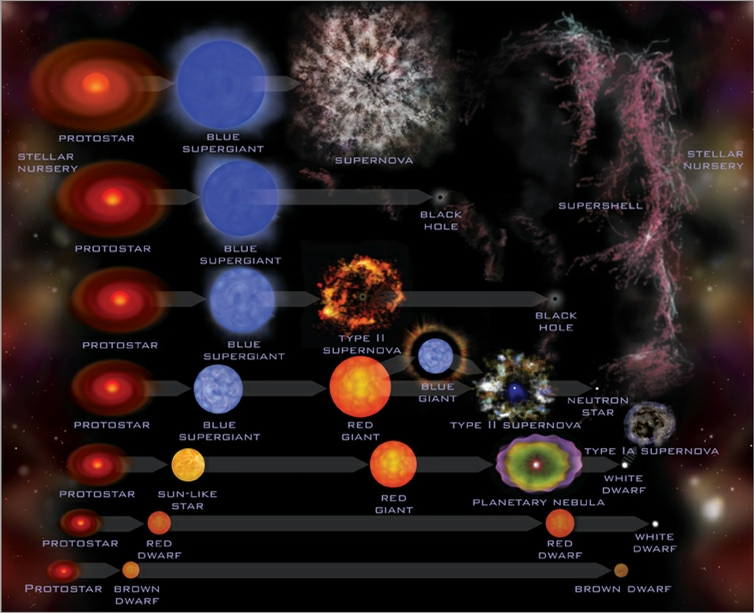
The image below, taken from NASA’s chandra.si.edu, summarises the typical stellar lifecycles by star mass.


References.


J. B. Kaler “Stellar evolution”, McGraw Hill, 2020.


Henny J.G.L.M. Lamers and Emily M. Levesque “Understanding Stellar Evolution”, IOPscience, 2017.

Stellar Evolution, MIT Press, 1972.


Degl’Innocenti Scilla, “Introduction to stellar evolution”, Journal of Physics: Conference Series, Volume 703, 8th European Summer School on Experimental Nuclear Astrophysics (Santa Tecla School) 13–20 September 2015, Santa Tecla, Italy.


D. M. Bowman, J. van Saders and J. S. Vink “The Structure and Evolution of Stars: Introductory Remarks”, MDPI 2023.


S. Kumar Kalaiselvi and Victoria Choi, Understanding the Importance of Stellar Birth and Evolution for a Comprehensive Understanding of the Sun and Other Stars

Harvard and Smithsonian Centre for Astrophysics: Stellar Structure and Evolution.


Harvard University Stellar Evolution – Cosmic Cycles of Formation and Destruction


Beccari, Giacomo ; Carraro, Giovanni “Introduction to the Theory of Stellar Evolution” Ecology of Blue Straggler Stars. Astrophysics and Space Science Library, Volume 413. ISBN 978-3-662-44433-7. Springer-Verlag Berlin Heidelberg, 2015.


Cohen, Martin. In Darkness Born: The Study of Star Formation. New York: Cambridge University Press, 1988.


Genet, Russell M., Donald S. Hayes, Douglas S. Hall, and David R. Genet. Supernova 1987a: Astronomy’s Explosive Enigma. Mesa, Ariz.: Fairborn Press, 1988.

Schneider, Stephen E., and Thomas T. Arny. Pathways to Astronomy. 2d ed. New York: McGraw-Hill, 2008.


E. E. Salpeter, S. W. Stahler, Berkeley, J. Najita, E. Churchwell, B. G. Elmegreen, J. Liebert, J. Andersen, Y. Lebreton, J. N. Bahcall, T. M. Brown, A. Maeder, P. P. Eggleton, C. A. Pilachowski, R. -P. Kudritzk, L. A. Willson, P. Podsiadlowski, D. E. Winget, D. F. Figer, G. Gonzalez, M. Bobrowsky, I. Iben, Jr “Unsolved Problems in Stellar Evolution”, Cambridge University Press, 2000.


S. Grossman “Double-diffusive mixing-length theory, semiconvection and massive star evolution”, 1996, Monthly Notices of the Royal Astronomical Society.

L. Fulmer, R. Hainich, H. Todt, A. C. Sander, John S. Gallagher, V. Ramachandran, T. Shenar, Wolf-Rainer Hamann, L. M. Oskinova, “Testing massive star evolution, star formation history, and feedback at low metallicity. Spectroscopic analysis of OB stars in the SMC Wing”, A&A 2019.


Diriba Gonfa Tolasa, “Stellar Evolution and Nucleosynthesis: Investigating the Life Cycles of Massive Stars and Their Role in Galactic Chemical Enrichment”, Engineering Physics (Volume 8, Issue 1), 2025.


Konstanze Zwintz, “The Power of Asteroseismology for Early Stellar Evolution”, Front. Astron. Space Sci., 13 December 2019 Sec. Stellar and Solar Physics Volume 6 - 2019


Page 1