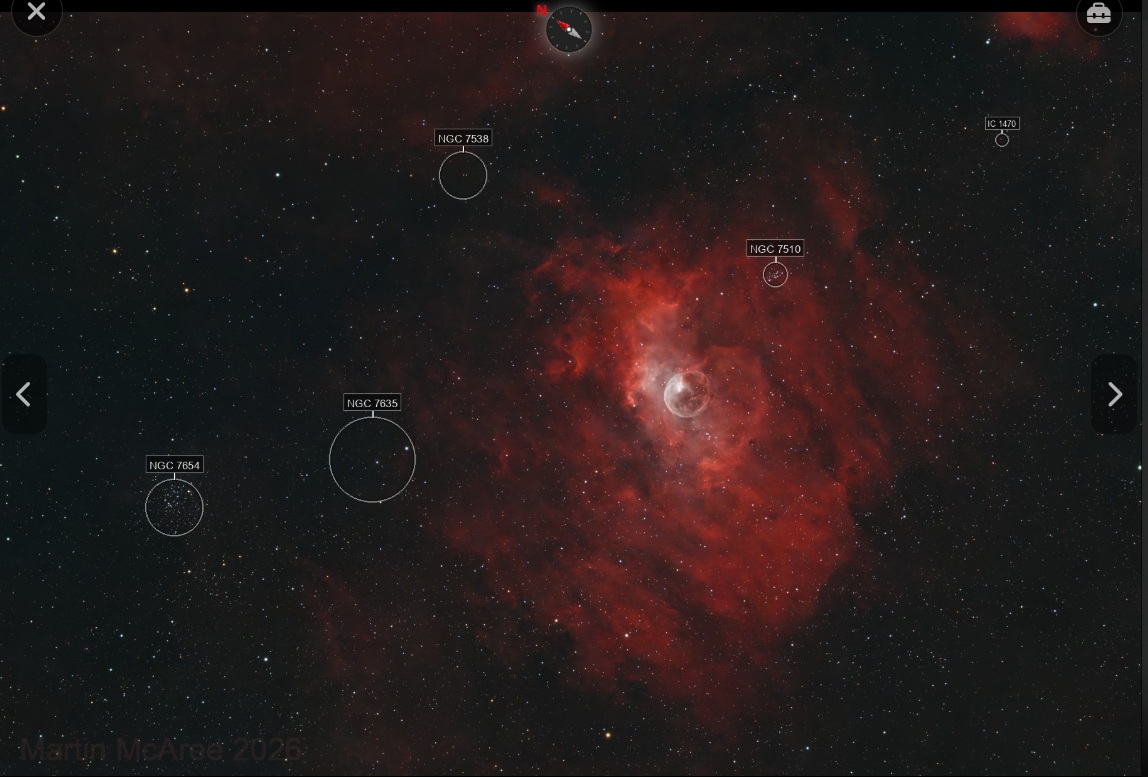
NGC 7635 The Bubble Nebula
Object
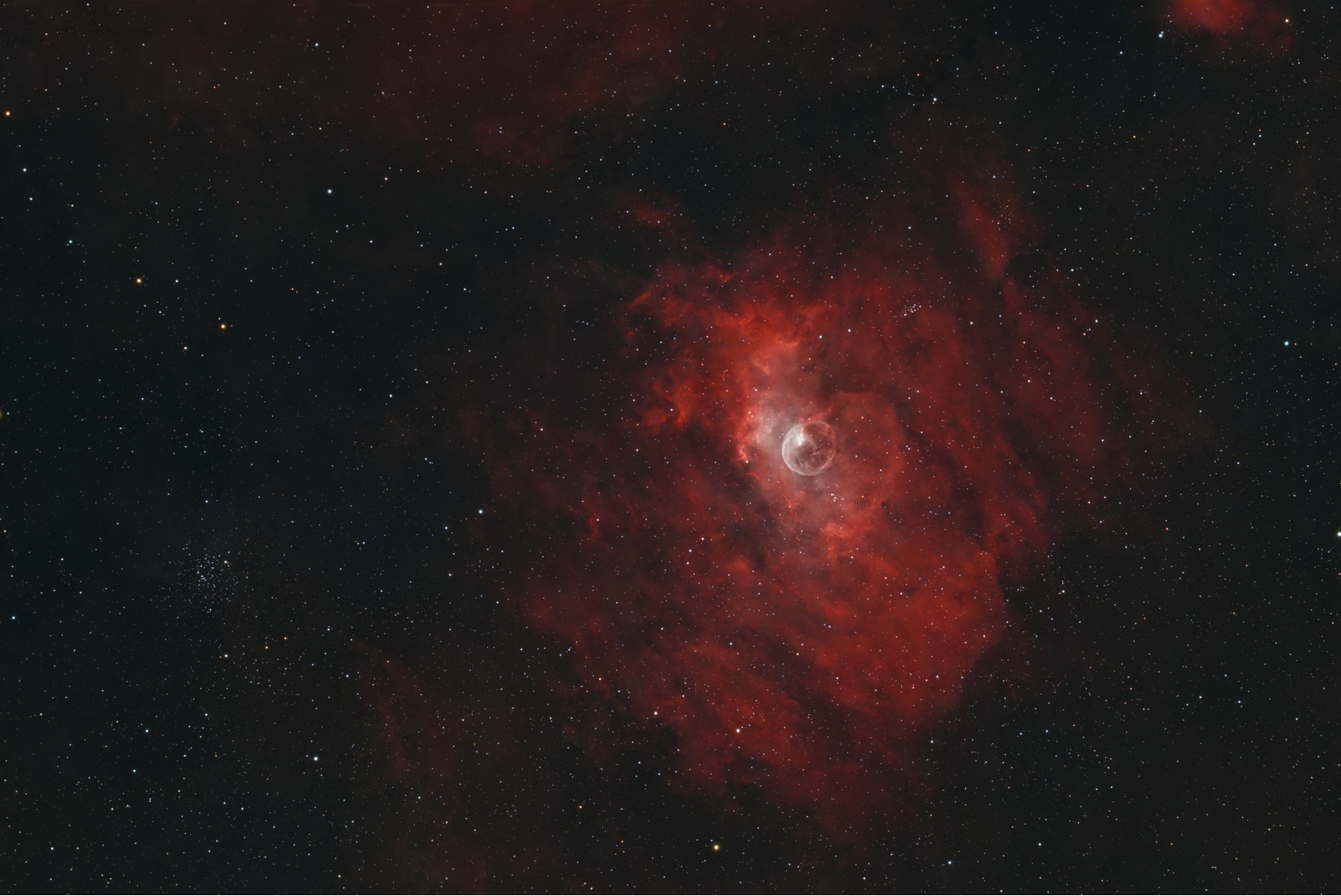
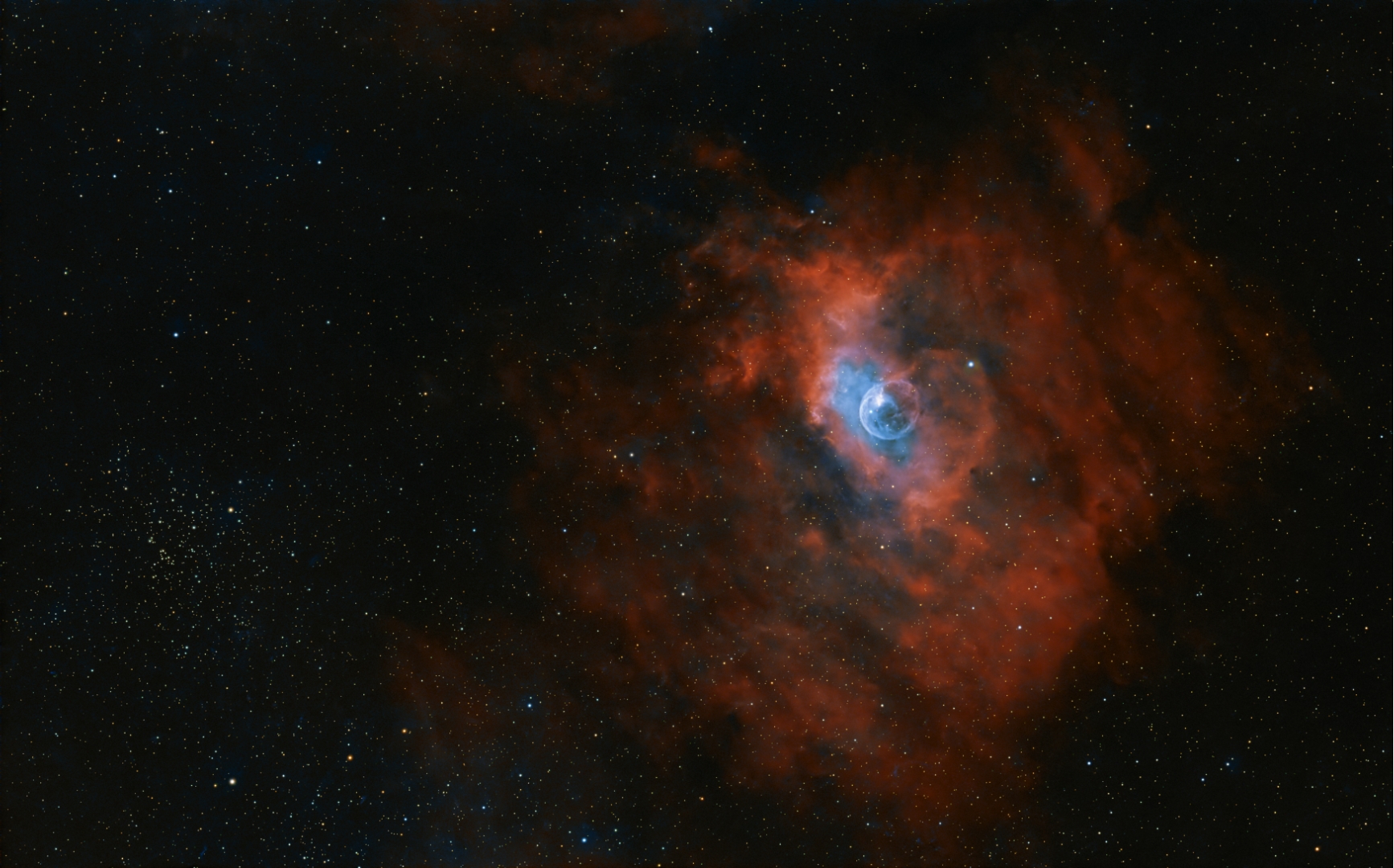
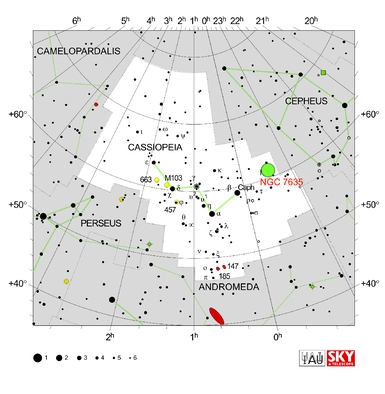
NGC 7635 or Sh 2-162, commonly known as the Bubble Nebula, is a striking emission
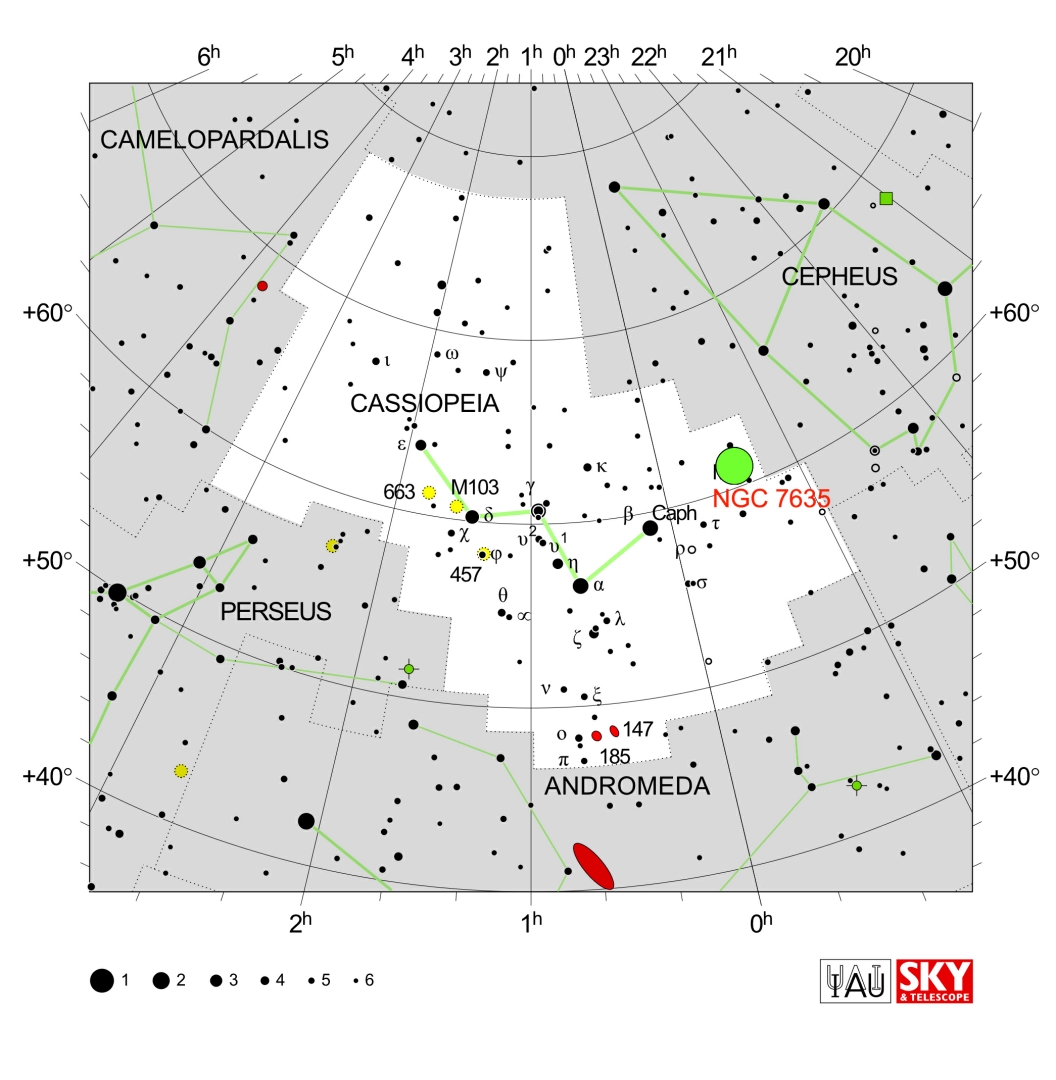
nebula located about 7,000 light-years away in the constellation Cassiopeia. It was
formed by the powerful stellar winds from a massive hot star called BD+60 2522, which
is pushing outward into the surrounding cloud of gas and dust. This interaction creates
a nearly spherical bubble approximately 10 light-years across, giving the nebula
its distinctive appearance. The Bubble Nebula glows primarily because ultraviolet
radiation from the central star ionizes the surrounding hydrogen gas, causing it
to emit light. Discovered in 1787 by William Herschel, NGC 7635 is a popular target
for both professional astronomers and amateur astrophotographers due to its beautiful
structure and vivid colors.
Image
Location: Cork city, Ireland (Bortle 7).
Date: 26th and 27th December 2025.
Seeing: Poor to average.
Moon Phase: Waxing Crescent, 35-37%.
Telescope: William Optics GT 81 Mk IV.
Barlow/Reducer: Willaim Optics Flat 6AIII 0.8X Flattener/Reducer.
Coma Corrector: N/A.
Other Optics: N/A.
Camera: ZWO ASi 2600 MC Pro
Filter 1: Optolong L-Ultimate dual band narrowband filter (3 nm).
Filter 2: Optolong Clear (for capturing RGB stars).
Controller: ZWO ASiair Pro
Guide Scope: William Optics M-G50WGIII 50 mm Guide Scope.
Guide Camera: ZWO Asi 120MM Mini Guide Camera.
Guiding Error: 1.24” to 0.56” RMS.
Mount: Sky Watcher EQ6-R Pro.
Image Processing:
Application 1: Graxpert.
Application 2: Pleiades Astrophoto PixInsight & Plugins.
Application 3: RC Astro BlurXTerminator.
Application 4: RC Astro StarXTerminator.
Application 5: RC Astro NoiseXTerminator.
Image Capture:
Light Frames: 56 x 180 s.
Flat Frames: 60.
Dark Frames: 30 x 180 s.
Bias Frames: 30.
Location Annotated
Image
History
NGC 7635 was discovered on 3 November 1787 by the British astronomer William Herschel
during his systematic survey of deep-sky objects. Herschel described it as a faint
nebulosity surrounding a star, long before astronomers understood the physical nature
of nebulae. During the nineteenth century, Herschel's son, John Herschel, re-observed
the object and included it in his General Catalogue of Nebulae and Clusters. Later,
the Danish astronomer John Louis Emil Dreyer incorporated it into the famous New
General Catalogue as NGC 7635, the designation by which it is known today. For much
of the twentieth century, astronomers regarded NGC 7635 as an unusual emission nebula.
Advances in spectroscopy and astrophysics eventually revealed that its distinctive
bubble-shaped shell is created by the powerful stellar wind of the massive O-type
star BD +60°2522. This star ejects material at extremely high speeds, sweeping up
the surrounding interstellar gas and producing a roughly spherical bubble about 7–10
light-years across.
Physics
NGC 7635 is an emission nebula situated in the northern constellation Cassiopeia.
It is also catalogued as Sharpless 2-162 and Caldwell 11. The nebula was discovered
by William Herschel in 1787 and is now recognized as one of the clearest known examples
of a stellar-wind bubble surrounding a massive star. Distance estimates for NGC 7635
have varied because of uncertainties in the distance and association membership of
its exciting star. Frequently cited values place the nebula approximately 2.1–2.5
kiloparsecs, or roughly 7,100–8,000 light-years, from Earth. Its projected shell
is approximately seven light-years across. NGC 7635 forms part of a substantially
larger ionized and molecular complex in the Perseus spiral arm of the Milky Way.
The nebula is scientifically important because it provides a nearby laboratory for
studying the effects of massive stars on their environments. These effects include
photoionization, stellar-wind shocks, gas compression, cloud erosion, turbulence
and, potentially, the triggering or suppression of subsequent star formation.
The central star BD+60°2522
The principal source of energy within NGC 7635 is BD+60°2522, also known as SAO 20575.
It is a highly luminous O-type star generally assigned a spectral classification
close to O6.5. Estimates of its physical properties depend on the adopted stellar
atmosphere model and distance, but its initial mass was probably several tens of
solar masses. The high effective temperature of BD+60°2522 produces an intense ultraviolet
radiation field. Photons with energies greater than 13.6 electron volts ionize the
surrounding hydrogen:
H + hv → H+ + e-
(Neutral hydrogen absorbs a photon and results in a hydrogen ion (a proton) and an
ejected electron)
When electrons subsequently recombine with protons, the gas emits radiation at characteristic
wavelengths. Hydrogen-alpha emission at 656.3 nanometres is particularly prominent,
while collisionally excited lines from ions such as [O III], [N II] and [S II] provide
information about gas temperature, ionization and shock conditions. BD+60°2522 also
loses material through a fast stellar wind with a terminal velocity of approximately
2000 km/s. The wind carries mass, momentum and mechanical energy away from the stellar
surface. Its mechanical luminosity is approximately:
Lw = ½ M v ͚2
(Not to be confused with photo-luminosity, Lw is the rate at which a star releases
kinetic energy through its out flowing stellar wind.)
Where M is the stellar mass-loss rate and v ͚ is the terminal wind velocity. Even
when the mass-loss rate represents only a small fraction of the star’s mass per year,
the extremely high wind velocity produces a substantial mechanical-energy output.
Formation of the Bubble
The formation of NGC 7635 can be interpreted using the standard wind-blown-bubble
model. In this model, a supersonic stellar wind collides with the surrounding interstellar
medium and produces several dynamically distinct regions:
- A freely expanding stellar wind close to the star.
- A termination shock that slows and heats the wind.
- A cavity containing hot, shocked stellar-wind material.
- A contact discontinuity separating stellar material from swept-up interstellar gas.
- An outer shell of compressed gas bounded by a forward shock or ionization front.
The wind initially expands nearly freely but eventually encounters sufficient external
material to form a shock. Because shock temperature scales approximately with the
square of velocity:
Ts ≈ 3μmpvs2/16k
Here:
Ts is the post-shock gas temperature in kelvin.
μ is the mean molecular weight per particle. For fully ionized gas of approximately
solar composition, μ ≈ 0.61 .
mp is the proton mass, 1.67 x 10⁻²⁷ kg.
vs is the shock velocity in m/s.
K is the Boltzmann constant, 1.380649 × 10⁻²³ m2 kg s-2 K-1
The factor 3/16 follows from the Rankine–Hugoniot relations for a strong, non-radiative
shock in a monatomic ideal gas.
A wind moving at thousands of kilometres per second may theoretically generate gas
at millions of kelvins. This hot interior gas exerts pressure on the surrounding
medium and helps drive the expansion of the visible shell. Spectroscopic observations
indicate that the bright shell itself expands much more slowly than the stellar wind.
A detailed kinematic investigation reported an expansion velocity of approximately
15 km/s for the main bubble. The difference between the wind and shell velocities
occurs because the wind transfers its momentum and energy to a much larger mass of
interstellar material.
Morphology and Environmental Interaction
Although NGC 7635 appears approximately spherical, its structure is not perfectly
symmetrical. BD+60°2522 is projected away from the geometrical centre of the visible
bubble. This apparent displacement was historically interpreted as possible evidence
that the star was moving rapidly through the surrounding gas. However, modern observations
indicate that the nebular morphology is also strongly affected by a nonuniform external
medium. On one side of the nebula, the expanding shell encounters dense molecular
material. Expansion is slowed in this direction, while it proceeds more rapidly into
lower-density regions. Consequently, the shell becomes brighter, thicker and more
sharply defined where it strikes dense gas. The bubble’s asymmetry therefore records
the density distribution and pressure structure of the surrounding interstellar medium.
Dense pillars and knots occur near the shell and within the neighbouring molecular
cloud. These formations consist of relatively cool gas and dust exposed to ultraviolet
radiation from BD+60°2522. Their surfaces are ionized and heated, while their interiors
remain partially shielded. Gas may stream away from the illuminated surfaces through
photoevaporation. Over time, the combined effects of radiation and stellar winds
erode and reshape these structures. The position of BD+60°2522 may nevertheless contribute
to the observed geometry. Its spatial motion relative to the surrounding cloud, combined
with density gradients and three-dimensional projection effects, can produce a star
that appears strongly displaced even when it remains dynamically associated with
the bubble.
Emission Line Structure
NGC 7635 is visible because the gas absorbs ultraviolet radiation and re-emits part
of that energy at optical and infrared wavelengths. Hydrogen-alpha traces ionized
hydrogen, while forbidden lines from oxygen, nitrogen and sulphur reveal differences
in excitation and temperature. The [O III] emission is strongest in relatively highly
ionized gas close to the exciting star and along parts of the inner shell. [N II]
and [S II] emission tends to become more prominent in lower-ionization zones, dense
filaments and shock-affected boundaries. Ratios between these emission lines allow
astronomers to distinguish material dominated by photoionization from regions in
which shock heating makes a significant contribution.
Images obtained with the Hubble Space Telescope resolve narrow filaments, ionization
fronts and small-scale density variations. Hubble observations made with the Wide
Field Camera 3 employed narrowband filters centred on [O III], Hα and [N II]. These
observations demonstrate that the familiar colour image is not a representation of
ordinary visual colour alone; it maps the spatial distribution of selected emission
lines.
The Wind-Energy Discrepancy
NGC 7635 is frequently presented as a textbook stellar-wind bubble, but detailed
studies show that its physical state is more complicated than the simplest analytical
models predict. If the stellar wind retained most of its mechanical energy, the resulting
hot interior should produce stronger diffuse X-ray emission and possibly faster shell
expansion. Observations instead suggest that only part of the injected wind energy
remains as thermal or kinetic energy within the observable bubble. Several processes
could account for this apparent energy deficit:
- Radiative cooling may remove energy from the shocked gas.
- Thermal conduction may transport heat into the cool shell.
- Turbulent mixing may combine hot wind material with cooler nebular gas.
- Openings in the shell may permit hot plasma to escape.
- Stellar mass-loss rates may be overestimated if wind clumping is neglected.
- The surrounding medium may be more structured than assumed in idealized models.
The absence or weakness of strong diffuse X-ray emission is therefore scientifically
significant. It indicates that the conversion of wind power into observable hot gas
is inefficient or that the bubble is not a completely closed structure. NGC 7635
consequently provides an important test of models of feedback from massive stars.
Star Formation and Interstellar Feedback
The relationship between stellar feedback and star formation in the NGC 7635 region
is complex. An expanding shell can compress molecular gas, potentially encouraging
gravitational collapse in sufficiently dense regions. This mechanism is often described
as triggered star formation. Conversely, ultraviolet radiation, photoevaporation
and mechanical disruption can disperse molecular material and inhibit the formation
of stars. Determining which process dominates requires evidence that young stellar
objects are physically associated with compressed structures and younger than the
exciting star and nebular shell. The presence of dense pillars or infrared sources
near the bubble is suggestive, but morphology alone does not conclusively demonstrate
triggered star formation.
NGC 7635 should therefore be interpreted as part of a dynamic star-forming complex
rather than as an isolated spherical shell. Its evolution is governed by the interaction
of radiation, winds, pre-existing cloud structure and the motion of the exciting
star.
Future Evolution
BD+60°2522 is a massive and comparatively short-lived star. As it evolves, changes
in its temperature, radius and mass-loss rate will modify the surrounding nebula.
It may pass through a supergiant or heavily stripped evolutionary phase before undergoing
core collapse. The final outcome will probably be a core-collapse supernova, leaving
either a neutron star or, depending on its final core mass and mass-loss history,
a black hole. A future supernova shock would expand into a medium already modified
by the present stellar wind. Rather than encountering a uniform interstellar environment,
the ejecta would initially propagate through the low-density wind cavity before colliding
with the dense outer shell. This interaction could strongly influence the morphology,
luminosity and chemical evolution of the resulting supernova remnant.
References
ESA/Hubble. “The Bubble Nebula.” Hubble Space Telescope image and observational data,
2016. ESA/Hubble
NASA Science. “Bubble Nebula (NGC 7635).” Hubble Space Telescope observations. NASA
Science
Toalá, J. A., Guerrero, M. A., Chu, Y.-H., et al. 2020. “Bubble Nebula NGC 7635—Testing
the Wind-Blown Bubble Theory.” Monthly Notices of the Royal Astronomical Society,
495, 3041–3055. MNRAS article
Weaver, R., McCray, R., Castor, J., Shapiro, P., & Moore, R. 1977. “Interstellar
Bubbles. II. Structure and Evolution.” The Astrophysical Journal, 218, 377–395.
Resources
The Bubble Nebula NGC 7635 – testing the wind-blown bubble theory. Toala et al 2020.
ABSTRACT: We present a multiwavelength study of the iconic Bubble Nebula (NGC 7635)
and its ionising star BD+60◦2522. We obtained XMM-Newton EPIC X-ray observations
to search for extended X-ray emission as in other similar wind-blown bubbles around
massive stars. We also obtained San Pedro Mártir spectroscopic observations with
the Manchester Echelle Spectrometer to study the dynamics of the Bubble Nebula.
Although our EPIC observations are deep, we do not detect extended X-ray emission
from this wind-blown bubble. On the other hand, BD+60◦2522 is a bright X-ray source
similar to other O stars. We used the stellar atmosphere code PoWR to characterise
BD+60◦2522 and found that this star is a young O-type star with stellar wind capable
of producing a wind-blown bubble that in principle could be filled with hot gas.
We discussed our findings in line with recent numerical simulations proposing that
the Bubble Nebula has been formed as the result of the fast motion of BD+60◦2522
through the medium. Our kinematic study shows that the Bubble Nebula is composed
by a series of nested shells, some showing blister-like structures, but with little
signatures of hydrodynamical instabilities that would mix the material producing
diffuse X-ray emission as seen in other wind-blown bubbles. Its morphology seems
to be merely the result of projection effects of these different shells.
Link to Paper
Evolution effect of BD+60°2522 to Bubble Nebula NGC 7635. Aprilia et al 2016.
Abstract: Bubble Nebula is a bubble formed by the interaction between the stellar
wind of BD+60°2522 with ambient interstellar gas. We use a web-based stellar evolution
code, the EZ- web, to construct the evolution of BD+60°2522. From the evolution,
we obtain the age of the system needed for the interstellar bubbles model. Then from
the model, we determine parameters such as radius, expansion velocity, luminosity,
temperature, and density of the Bubble.
Link to Paper
Hubble Space Telescope Observations of the Windblown Nebula NGC 7635. Moore et al
2002.
ABSTRACT: We present Hubble Space Telescope observations of the northern part of
NGC 7635, a circular shell around the O6.5 IIIf star BD 60°2522. The nebula, which
lies within the large emission-line region S162, is notable not only for its symmetric
shell, but also for a complex of ``cometary'' knots close to the central star. Our
observations include spectra taken with the Space Telescope Imaging Spectrograph
and narrowband images taken with the Wide Field Planetary Camera 2. The high spatial
resolution of these data reveals the knots to be the ionized edges of a much larger
mass of neutral material, with strong photoevaporative flows toward the central star.
The cometary appearance of the knots is produced by the intersection of two ridges,
one in the plane of the sky and the other 65° relative to it. Stratification in the
emission from the shell can also be seen, the result of shock heating as material
is swept into the expanding shell. We also see for the first time a small loop of
emission between the central star and the cometary knot complex. We propose that
this was formed by the collision between the strong stellar wind and the photoevaporative
flow from the closest and brightest of these knots. Based on observations made with
the NASA/ESA Hubble Space Telescope, obtained at the Space Telescope Science Institute
(STScI), which is operated by the Association of Universities for Research in Astronomy
(AURA), Inc., under NASA contract NAS 5-26555.
Link to Paper