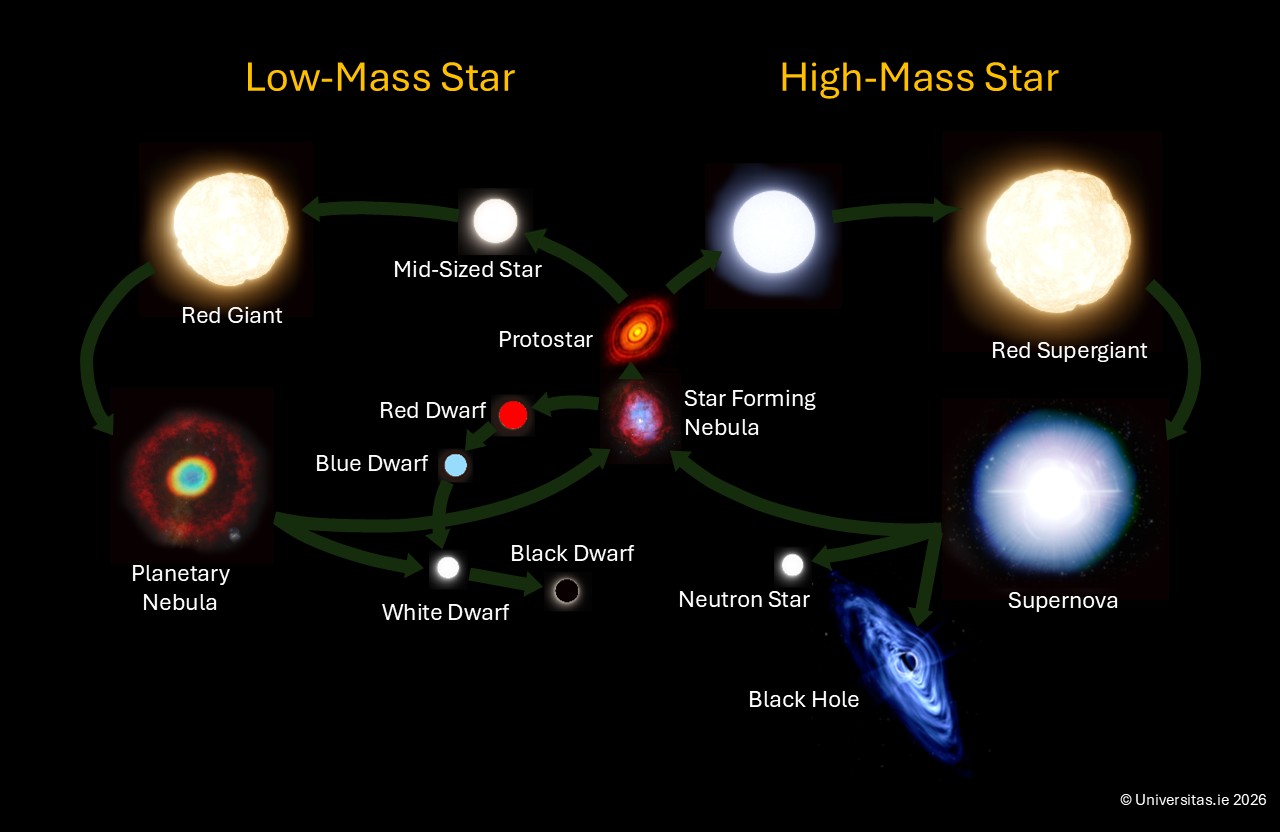
Stars form within large, cold reservoirs of molecular gas known as giant molecular
clouds (GMCs). These clouds are typically massive, often containing tens of thousands
of solar masses, and their internal dynamics governed by the interplay of turbulence,
self-gravity, and magnetic fields control the processes of star formation and early
stellar evolution. These dynamics are commonly described within the theoretical framework
of magnetohydrodynamics. As a molecular cloud undergoes gravitational contraction,
it fragments into progressively smaller and denser substructures, a process regulated
by the Jeans criterion.
The Jeans mass defines the critical mass at which the gravitational self-attraction
of a cold, dense molecular cloud overcomes its internal thermal pressure, initiating
gravitational instability and collapse. When the mass of a cloud or fragment exceeds
its corresponding Jeans mass, collapse becomes runaway, leading to the formation
of protostellar objects. During the early stages of collapse, cloud fragments often
remain approximately isothermal, as radiative cooling is efficient. As density increases
under isothermal conditions, the Jeans mass decreases, promoting further fragmentation
into multiple protostellar cores. The Jeans mass therefore determines the characteristic
mass scale of these fragments and sets a lower limit on initial stellar masses.
Within each fragment, a dense core forms and continues to contract under gravity.
As contraction proceeds, the core grows through the accretion of surrounding gas,
converting gravitational potential energy into thermal energy and causing the core
temperature to rise. Continued accretion leads to the formation of a protostar, which
accumulates mass through a circumstellar accretion disk. During this phase, the protostar
frequently drives powerful bipolar jets and molecular outflows, which play a crucial
role in removing excess angular momentum and regulating further accretion.
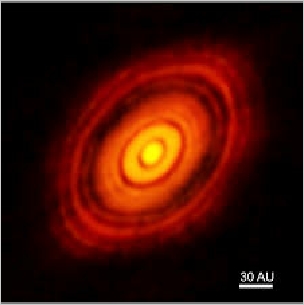
As the density of the collapsing core increases sufficiently, the gas becomes optically
thick, reducing radiative cooling efficiency. The resulting rise in temperature increases
the Jeans mass, suppressing further fragmentation and effectively determining the
final stellar mass. The protostar then evolves through a sequence of pre-main-sequence
stages. Initially, it is deeply embedded within a dusty envelope and is observable
primarily at infrared wavelengths. For low-mass stars, this evolution commonly includes
the T Tauri phase, which represents a critical pre-main-sequence stage for stars
with masses below approximately two solar masses and ages less than about ten million
years. T Tauri stars are characterized by ongoing contraction, active accretion from
a circumstellar disk, strong stellar winds, significant photometric variability,
and the absence of sustained nuclear fusion, with luminosity generated primarily
by gravitational contraction.
As contraction continues, the core temperature eventually reaches approximately 10,000
K, enabling hydrogen nuclei to undergo nuclear fusion and form helium. The onset
of nuclear fusion releases substantial energy, and the resulting outward pressure
balances the inward pull of gravity. This establishes hydrostatic equilibrium, marking
the star’s arrival on the main sequence.
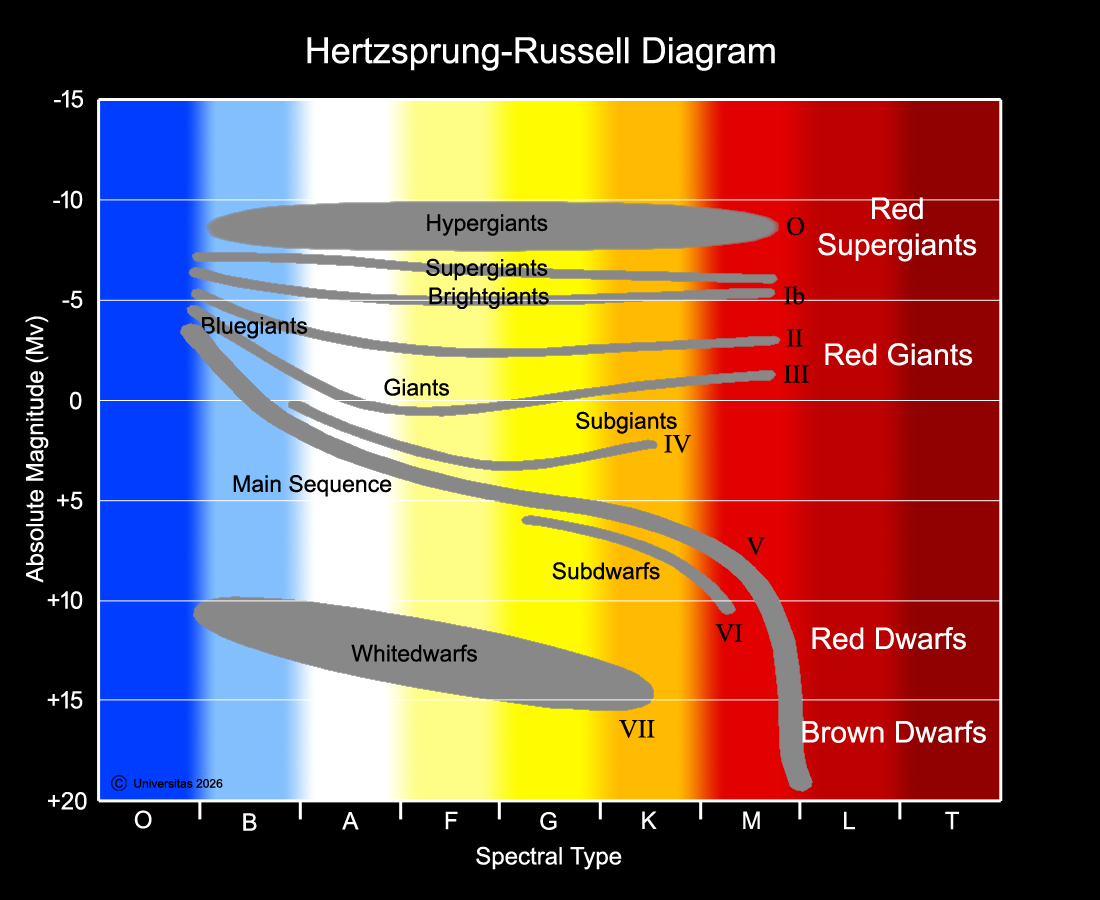
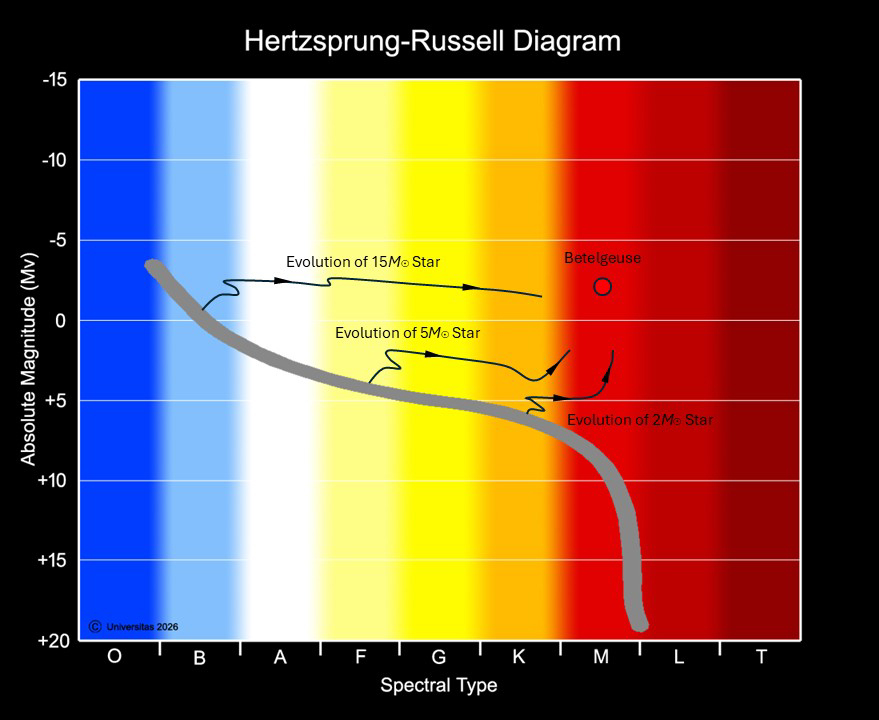
H–R diagram is a two-dimensional graphical representation that correlates stellar
luminosity with spectral type. It was developed independently in the early twentieth
century by the American astronomer Henry Norris Russell and the Danish astronomer
Ejnar Hertzsprung, in 1913 and 1911 respectively. An understanding of the H–R diagram
is fundamental to the study of stellar structure and evolution.
When stars are plotted on the diagram—typically with absolute magnitude or luminosity
on one axis and spectral type or effective temperature on the other—they are not
distributed uniformly. Instead, they occupy distinct regions or sequences. The majority
of stars, approximately 90 percent, lie along a well-defined diagonal band known
as the main sequence, which extends from hot, luminous stars to cool, faint ones.
In addition to the main sequence, evolved giant stars populate a separate region
at higher luminosities, while the most luminous and rare supergiant stars form another
distinct grouping. White dwarfs and other stellar populations also occupy characteristic
regions of the diagram.
There are several form of the H-R diagram, but all plot the absolute visual magnitude
on the vertical axis, and either the spectral class or temperature on the horizontal
axis. The surface temperatures of the main stars range from 3000 K (spectral class
M) to more than 30,000 K (spectral class O). The range in luminosities varies considerably
from -10 to +14.
There are a number of important areas or branches of the H-R diagram that will be
explained later, but it is important to identify them before going on:
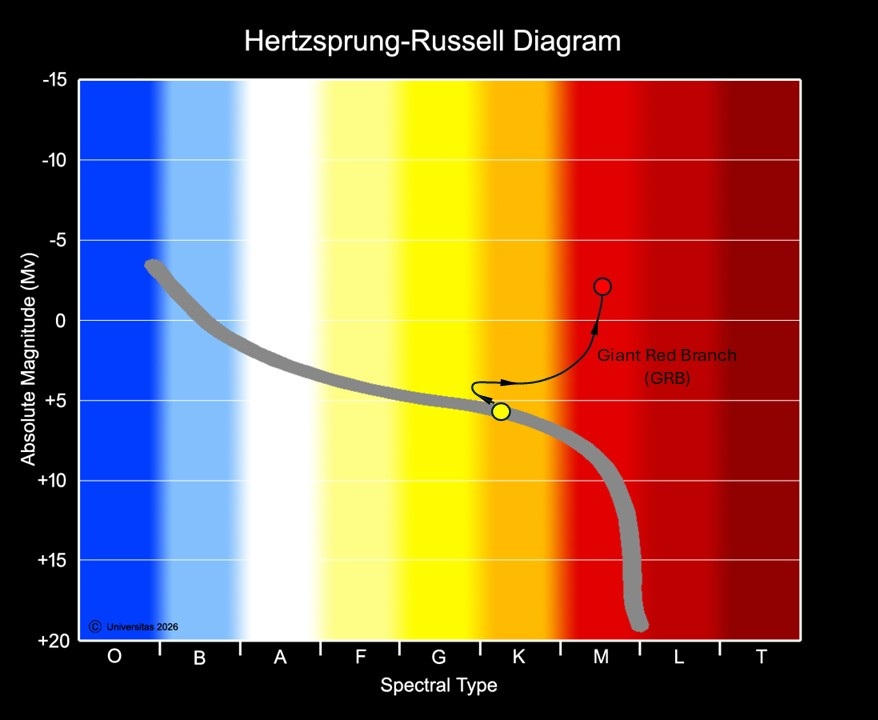
- Red giant branch: The red-giant branch (RGB), also known as the first giant branch,
constitutes a distinct phase of stellar evolution in low- to intermediate-mass stars
following their departure from the main sequence and preceding the ignition of helium
burning in the core. In this phase, the stellar interior is characterized by an inert,
electron-degenerate helium core encircled by a hydrogen-burning shell, with nuclear
energy production predominantly proceeding through the carbon–nitrogen–oxygen (CNO)
cycle. Stars on the red-giant branch generally exhibit K- and M-type spectral classifications
and are distinguished by radii and luminosities that are substantially greater than
those of main-sequence stars with comparable effective temperatures.
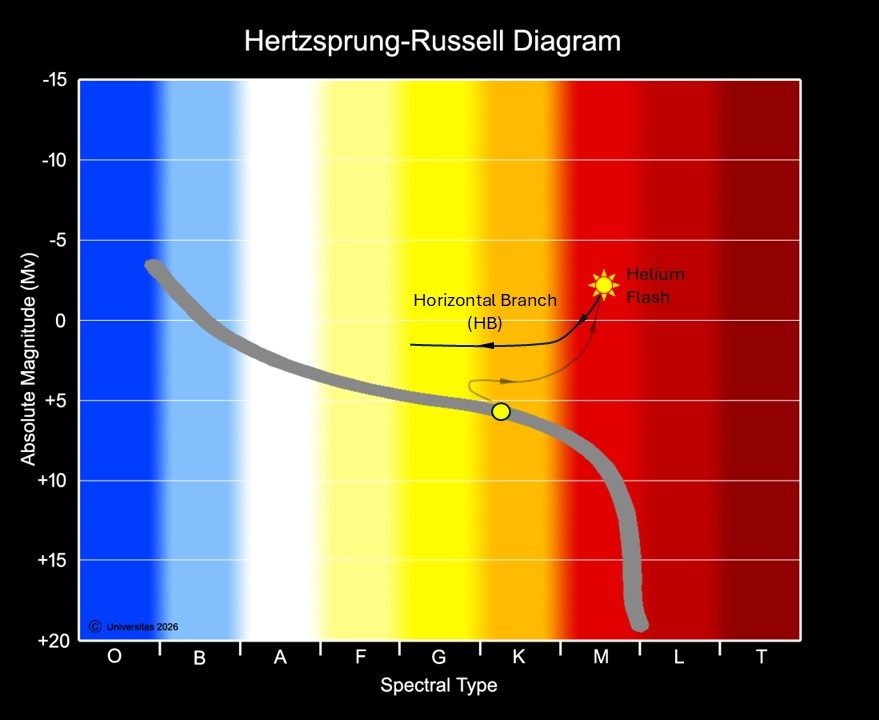
- Horizontal branch: The horizontal branch (HB) is a post–red-giant-branch phase of
stellar evolution experienced by low-mass stars with masses comparable to that of
the Sun. Stars on the horizontal branch are characterized by stable helium fusion
in their cores via the triple-alpha process, accompanied by hydrogen fusion in a
surrounding shell, primarily through the carbon–nitrogen–oxygen (CNO) cycle. The
initiation of core helium burning at the tip of the red-giant branch—commonly referred
to as the helium flash—produces significant structural reconfiguration of the star.
This transition leads to a decrease in overall luminosity, partial contraction of
the stellar envelope, and an increase in surface temperature, causing the star to
migrate to the horizontal branch region of the Hertzsprung–Russell diagram.
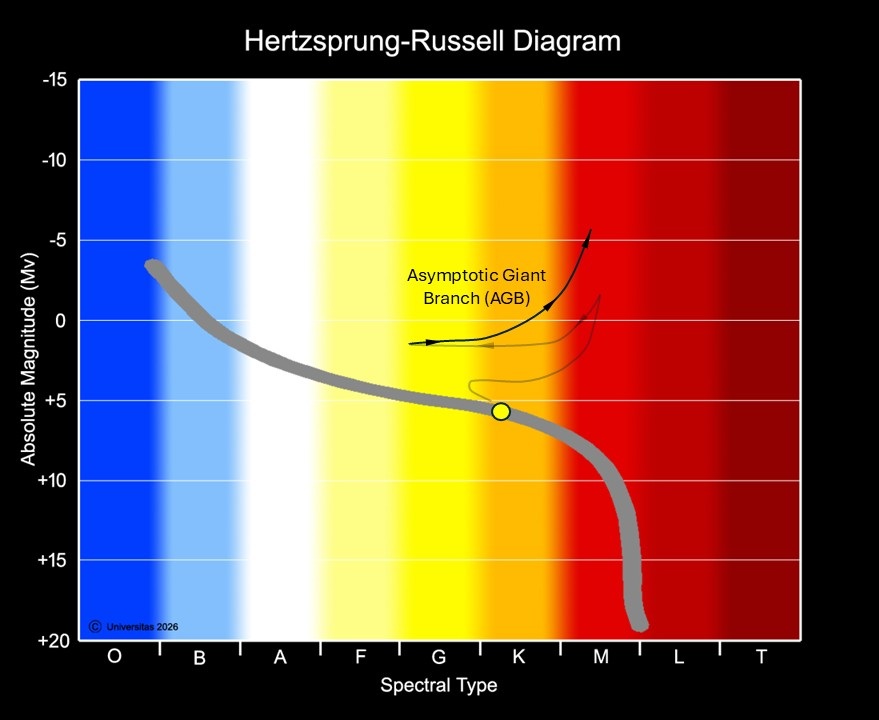
- The Asymptotic Giant Branch (AGB) is a distinct region of the Hertzsprung–Russell
diagram occupied by evolved, cool, and highly luminous stars. This phase represents
a late stage in the evolution of all low- to intermediate-mass stars, with initial
masses in the approximate range of 0.5 to 8 solar masses. Stars enter the AGB after
the exhaustion of helium in their cores, following the horizontal-branch or red-clump
phase.
Observationally, AGB stars appear as bright red giants with luminosities reaching
several thousand times that of the Sun. Their internal structure is characterized
by a compact, largely inert carbon–oxygen core, surrounded by two nuclear-burning
shells: an inner helium-burning shell, where helium fuses into carbon via the triple-alpha
process, and an outer hydrogen-burning shell, where hydrogen fusion produces helium.
Surrounding these regions is an extensive convective envelope whose composition is
broadly similar to that of main-sequence stars, though surface abundances may be
altered by internal mixing processes.
A defining feature of AGB evolution is the occurrence of thermal pulses, also known
as helium shell flashes. These arise from thermally unstable helium burning in the
thin helium shell, leading to episodic, rapid increases in energy output. Thermal
pulses cause significant structural readjustments within the star and drive convective
mixing events, such as the third dredge-up, which transport nucleosynthesis products
(including carbon and s-process elements) from the interior to the stellar surface.
These processes play a major role in enriching the interstellar medium with heavy
elements.
AGB stars also experience intense mass loss through strong stellar winds, which are
driven by a combination of large-amplitude pulsations and radiation pressure acting
on dust grains formed in the extended, cool envelope. Over time, this mass loss removes
most of the stellar envelope, exposing the hot core. As the envelope is ejected,
it forms an expanding shell of ionized gas known as a planetary nebula, illuminated
by ultraviolet radiation from the newly revealed core.
Following the dispersal of the planetary nebula, the remnant stellar core cools and
contracts to become a white dwarf, typically composed of carbon and oxygen. The white
dwarf no longer undergoes nuclear fusion and evolves by gradually radiating away
its residual thermal energy. This final stage marks the end point of stellar evolution
for low- to intermediate-mass stars.
A star’s initial mass is the primary factor governing its luminosity, surface temperature,
lifetime, and ultimate evolutionary fate. Objects with masses below approximately
0.08 solar masses are unable to achieve the core temperatures and pressures required
for sustained hydrogen fusion and instead become brown dwarfs. Stars with sufficient
mass to initiate and maintain hydrogen fusion enter the main-sequence phase of stellar
evolution. During this phase, the star fuses hydrogen into helium in its core and
exists in a state of hydrostatic equilibrium, in which the inward force of gravity
is balanced by the outward pressure generated by nuclear fusion. The main-sequence
phase represents the longest and most stable stage of a star’s life.
Low mass stars (0.08 to 0.5 solar mass):
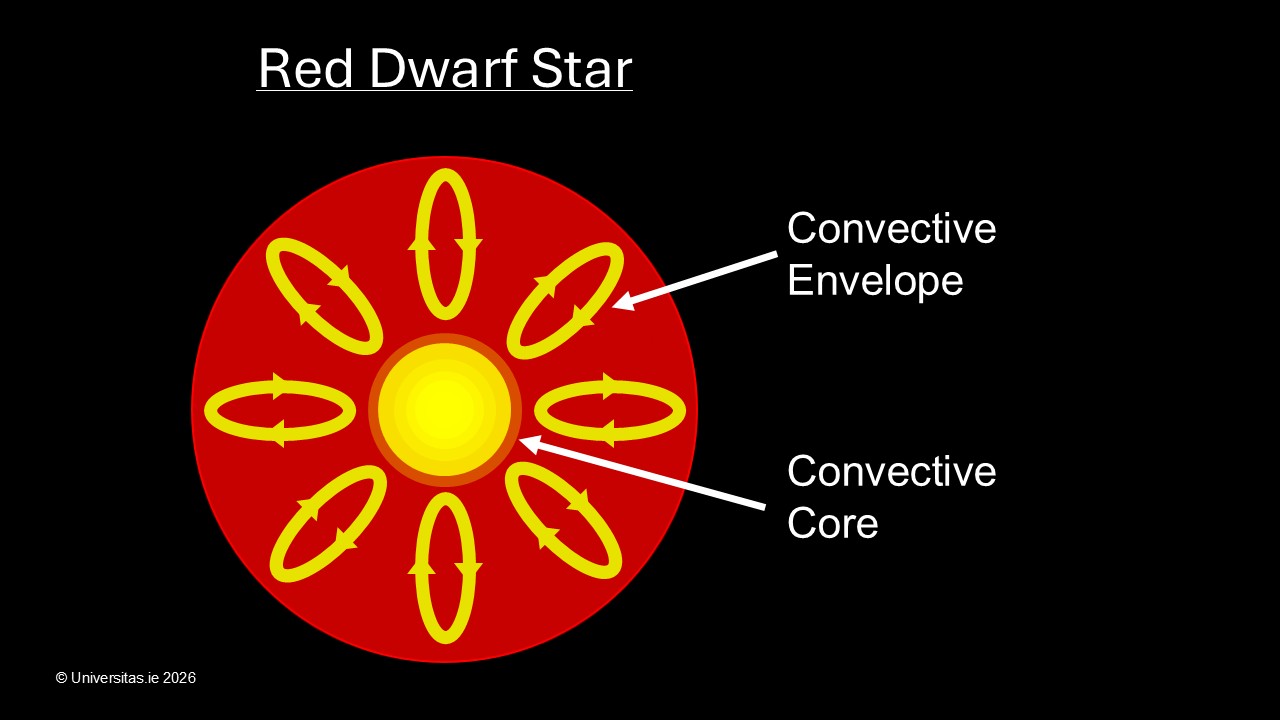
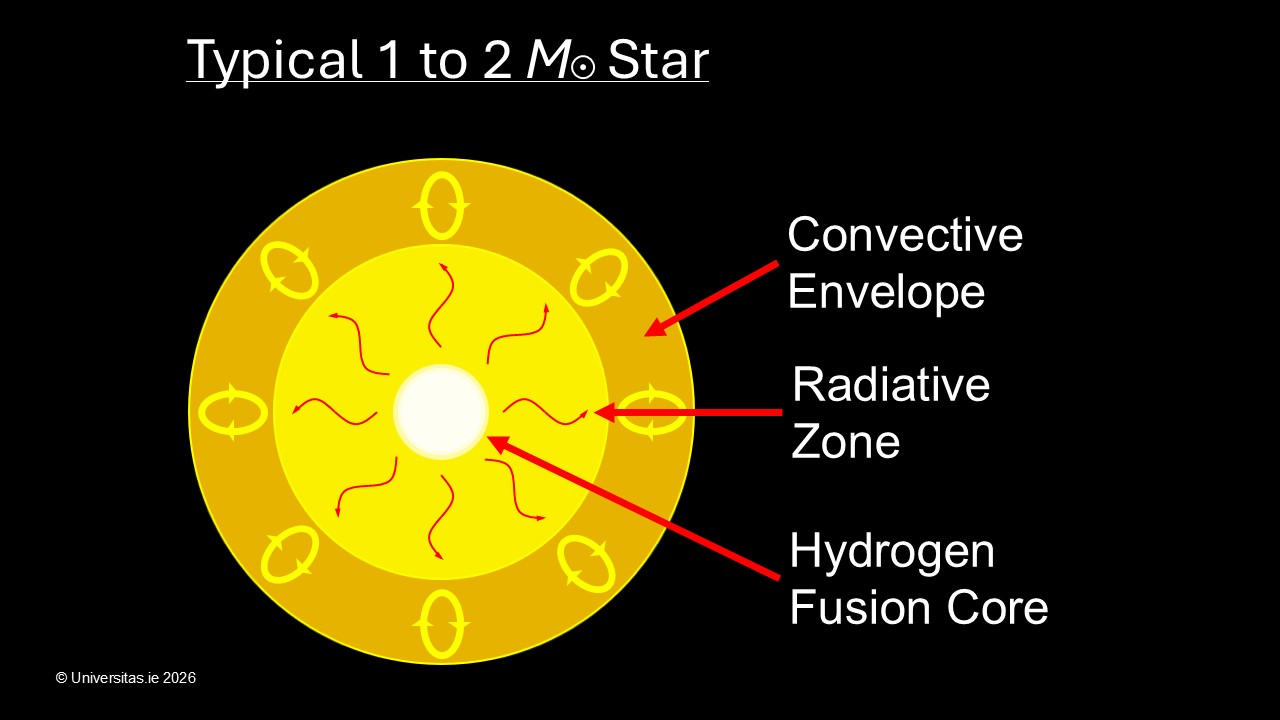
Low-mass stars, commonly referred to as red dwarf stars, are the smallest, coolest,
and least luminous hydrogen-burning stars in the Universe. Like all main-sequence
stars, they generate energy through the fusion of hydrogen into helium; however,
unlike the Sun, red dwarfs are fully convective. This means that material from the
entire star is efficiently mixed and transported to the core, allowing red dwarfs
to convert a much larger fraction of their hydrogen fuel into helium than more massive
stars. As a consequence of their efficient fuel usage and low luminosities, red dwarf
stars have exceptionally long lifetimes, extending up to approximately ten trillion
years, far exceeding the current age of the Universe. After exhausting their hydrogen
supply, these stars are expected to enter a post–main-sequence phase in which they
contract and increase in both temperature and luminosity, evolving into what are
termed blue dwarfs. This evolutionary stage remains purely theoretical, as red dwarfs
consume their fuel so slowly that insufficient time has elapsed since the formation
of the first stars for any blue dwarfs to exist.
In the final stages of their evolution, red dwarfs are predicted to transition into
white dwarfs once hydrogen fusion ceases and the stellar remnant cools. Over extremely
long timescales, these white dwarfs would continue to cool and fade, eventually becoming
black dwarfs, cold, inert stellar remnants rather than active stars. Notably, no
black dwarfs are expected to exist in the present Universe due to its finite age.
Intermediate-Mass Stars (0.6–10 Solar Masses):
Stars with initial masses of approximately 0.6–10 solar masses evolve into red giants
during their post–main-sequence evolution. Red giants are large, cool, and luminous
non-main-sequence stars, typically of spectral type K or M. On the Hertzsprung–Russell
(H–R) diagram, they occupy the upper-right region, reflecting their low effective
temperatures and high luminosities. Prominent examples include Aldebaran in the constellation
Taurus and Arcturus in Boötes.
Intermediate-mass stars pass through the red-giant phase during two distinct evolutionary
stages. The first is the red-giant branch (RGB), during which the star possesses
an inert helium core surrounded by a hydrogen-burning shell. Following this phase,
the star ignites helium in its core and enters the horizontal branch, characterized
by stable helium fusion in the core and hydrogen fusion in a surrounding shell. Many
helium-burning stars cluster toward the cooler end of the horizontal branch and are
classified as K-type giants, a population commonly referred to as the red clump.
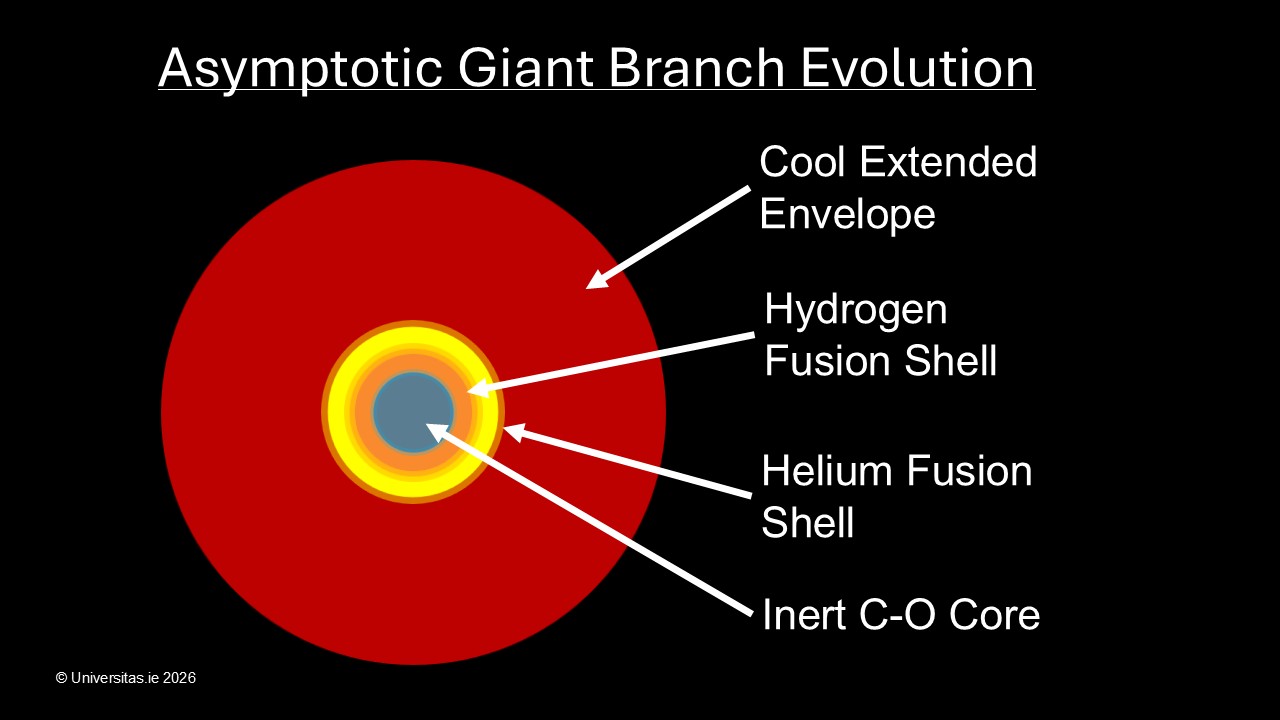
After core helium exhaustion, the star ascends the asymptotic giant branch (AGB).
During this phase, the stellar interior consists of an inert carbon–oxygen core,
an inner helium-burning shell, and an outer hydrogen-burning shell. The AGB represents
the final giant phase for low- to intermediate-mass stars prior to envelope ejection
and subsequent evolution toward the white dwarf stage.
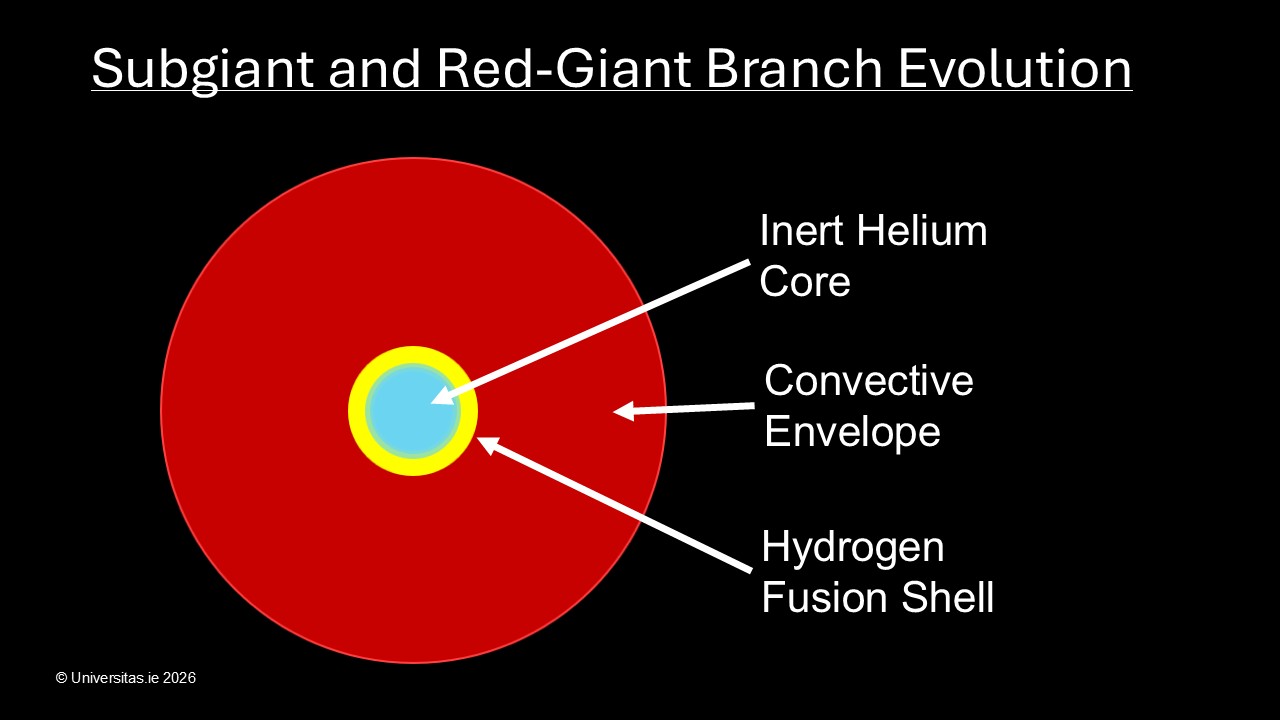
Subgiant and Red-Giant Branch Evolution:
In the subgiant phase, a star exhausts hydrogen in its core and leaves the main sequence.
Hydrogen fusion continues in a shell surrounding an inert helium core (Fig. 1), causing
helium to accumulate and the core mass to increase. This phase can last from several
million to a few billion years, during which the star gradually expands and cools,
with a luminosity comparable to or slightly lower than its main-sequence value. Eventually,
either the core becomes electron-degenerate (in solar-mass stars) or the outer envelope
becomes sufficiently opaque (in more massive stars). In both cases, the hydrogen-burning
shell heats up, increasing the star’s luminosity and driving substantial envelope
expansion. The star then ascends the red-giant branch on the H–R diagram.
Before we go on it’s important to understand what is meant by “electron-degenerate”
or “neutron degenerate”. In this case “degenerate” refers to degeneracy pressure.
Degeneracy pressure is a quantum mechanical force arising from the Pauli Exclusion
Principle, preventing fermions (like electrons or neutrons) from occupying the same
quantum state. It acts as a powerful outward pressure in extremely dense matter—such
as white dwarfs or neutron stars—resisting further gravitational collapse, and is
primarily dependent on density rather than temperature. In the case of a star it
often refers to the core. A degenerate star core is an extremely dense, compact stellar
center supported against gravity by quantum mechanical electron or neutron degeneracy
pressure rather than thermal pressure. Formed after nuclear fuel exhaustion in red
giants or supernovae, these cores (e.g., white dwarfs, neutron stars) are governed
by the Pauli exclusion principle. Mentioned before.
As the star climbs the RGB, its expanding outer envelope becomes strongly convective,
allowing material from regions near the hydrogen-burning shell to be mixed to the
surface. For all but the lowest-mass stars, nuclear fusion products had previously
remained confined to the stellar interior; this mixing therefore produces the first
dredge-up. While changes in hydrogen and helium isotopes are not directly observable,
the effects of CNO-cycle processing become detectable, including reduced C12/C13
ratios and altered surface abundances of carbon and nitrogen, which can be measured
spectroscopically.
In stars with initial masses of approximately 0.6–2.0 solar masses, the helium core
is supported by electron degeneracy pressure, causing helium fusion to ignite explosively
in a helium flash on timescales of days. In more massive stars, the helium core is
non-degenerate, and helium ignition occurs gradually without a flash. Although the
nuclear power released during the helium flash is enormous, briefly comparable to
the luminosity of an entire galaxy the energy is absorbed by rapid thermal expansion
of the core and is not directly observable at the stellar surface.
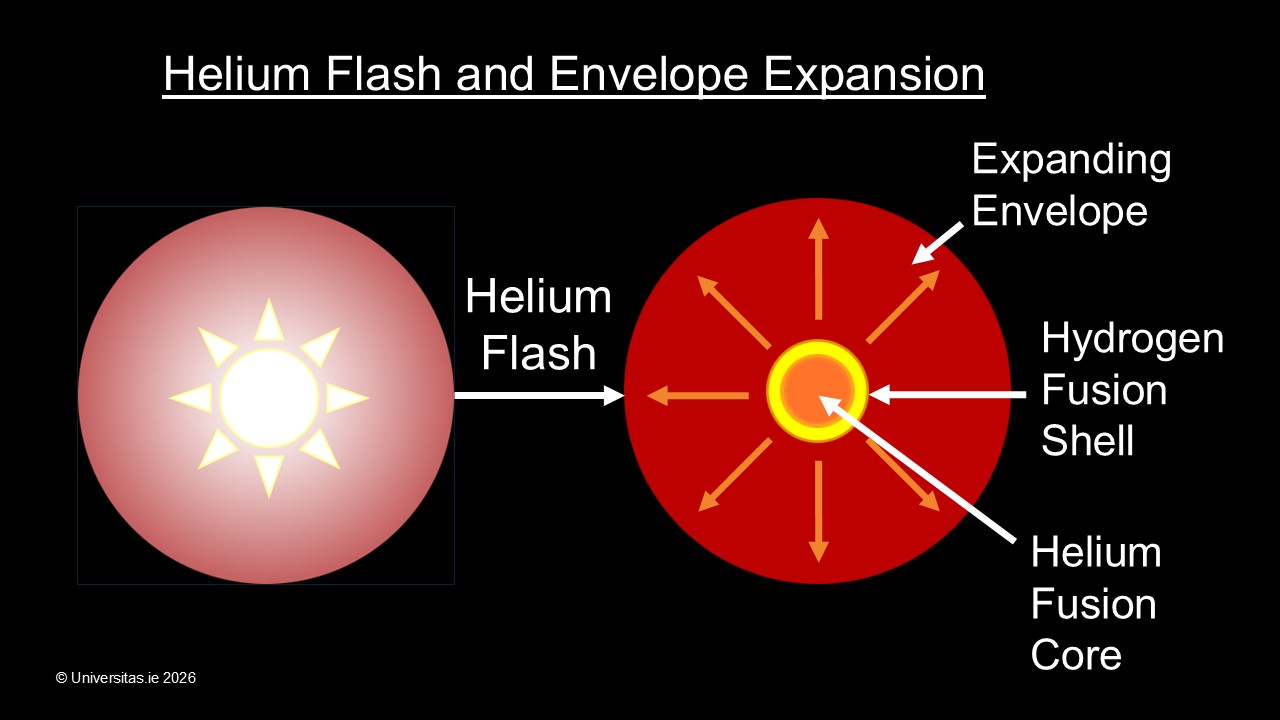
Following helium ignition, core expansion reduces the temperature and fusion rate
of the surrounding hydrogen-burning shell, leading to a temporary decrease in total
energy generation. The star subsequently contracts (though not back to the main sequence)
and migrates to the horizontal branch, becoming smaller and hotter at roughly constant
luminosity. Low-mass helium-flash stars populate the cool end of the horizontal branch,
forming the red clump, while higher-mass stars evolve to higher effective temperatures.
Some pass through the instability strip as RR Lyrae variables, and the most extreme
form blue tails or blue hooks. The detailed morphology of the horizontal branch depends
on metallicity, age, and helium abundance.
Meanwhile, the inert helium core continues to grow in mass and eventually becomes
either electron-degenerate or exceeds the Schönberg–Chandrasekhar limit. As a result,
the core temperature rises, increasing the rate of hydrogen-shell burning and driving
a steady increase in luminosity as the star approaches the tip of the RGB. Stars
with degenerate helium cores reach the RGB tip with nearly identical core masses
and luminosities, whereas more massive stars ignite helium earlier and do not reach
the RGB tip.
Asymptotic Giant Branch Evolution
After core helium exhaustion, hydrogen and helium fusion continue in concentric shells
surrounding an inert carbon–oxygen core. The star ascends the AGB, following a track
parallel to the RGB but at higher luminosities and over shorter timescales. Although
helium burns in an inner shell, most of the stellar energy output is generated by
hydrogen fusion in the outer shell. Helium produced in the hydrogen-burning shell
accumulates inward and periodically ignites unstable helium burning, producing thermal
pulses late in the AGB phase.
During AGB evolution, deep convection can transport fusion products to the surface
in second and third dredge-up events. These processes can enrich the surface with
carbon, leading to the formation of carbon stars, which are cool, highly luminous,
and exhibit strong carbon features in their spectra. In more massive AGB stars, hot
bottom burning can convert carbon into nitrogen and oxygen before it reaches the
surface, significantly influencing surface abundances and luminosity.
Many AGB stars exhibit large-amplitude pulsations. Mira variables show regular periods
of tens to hundreds of days and large visual brightness variations. In more massive
and luminous AGB stars, longer pulsation periods drive intense mass loss, producing
dust-enshrouded objects observable primarily in the infrared, including OH/IR stars
that exhibit hydroxyl maser emission. Both oxygen-rich and carbon-rich AGB stars
arise through the interplay of shell burning, dredge-up, and mass loss.