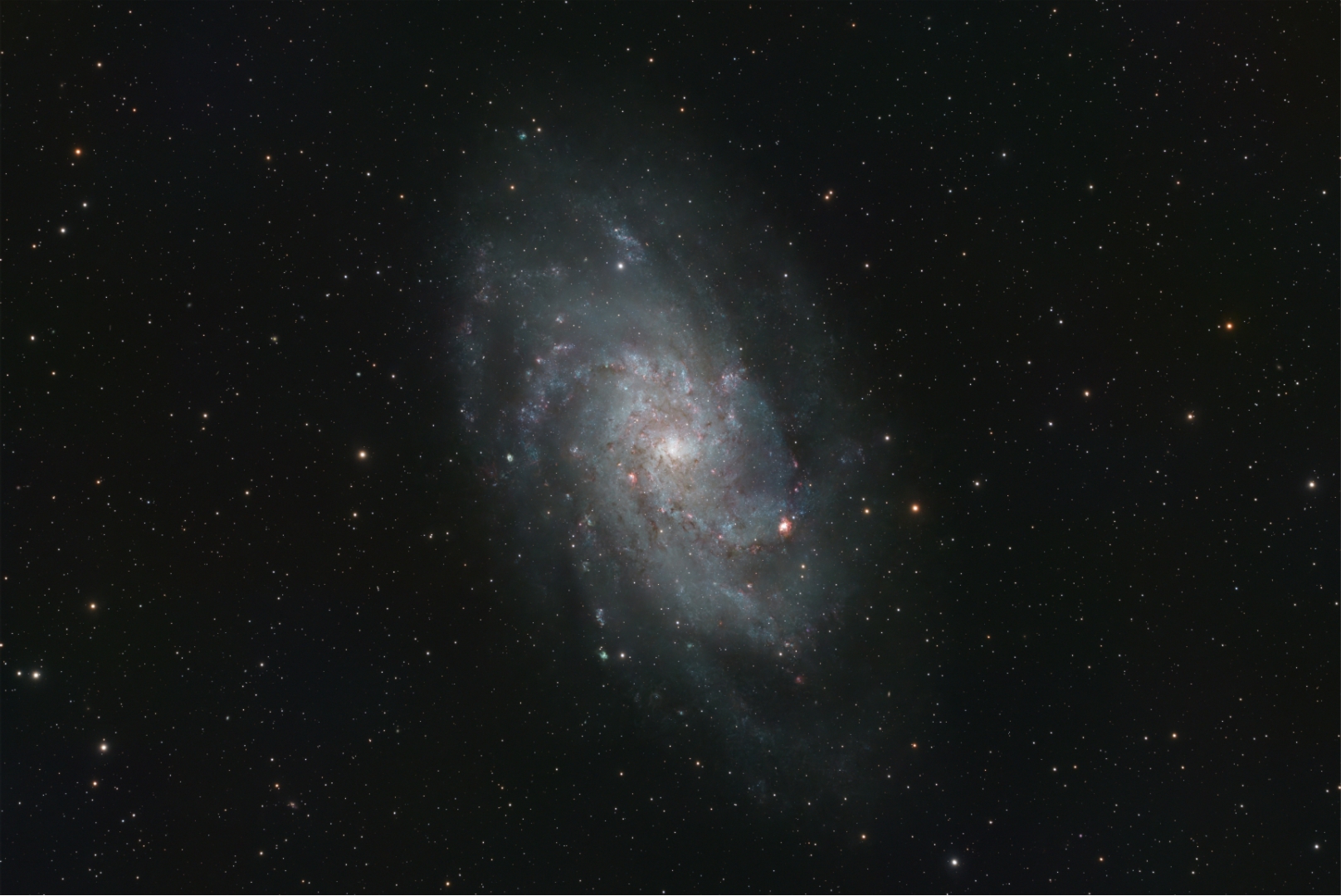
M 33 or Triangulum Galaxy.
Object
M33 or the Triangulum Galaxy is a relatively small but scientifically important spiral
galaxy. Its abundant star-
The Triangulum Galaxy has a diameter of approximately 60,000 light-
M33 is particularly valuable because of its relative proximity and active star formation. Astronomers use observations of its stars, gas, and stellar populations to study the relationship between star formation and galactic evolution. Its interaction with the gravitational environment of M31 and the Milky Way also provides insight into the dynamics of the Local Group.
Image
This image was taken over the nights of the 18th and 24th of November 2025. The image was captured with an OSC camera and processed primarily in PixInsight with plugins. The details are as follows:
Location: Cork city, Ireland (Bortle 7).
Date: 18th and 24th of November 2025.
Seeing: Poor to average.
Moon Phase: Waning Crescent, 2%.
Telescope: William Optics GT 81 Mk IV.
Barlow/Reducer: Willaim Optics Flat 6AIII 0.8X Flattener/Reducer.
Coma Corrector: N/A.
Other Optics: N/A.
Camera: ZWO ASi 2600 MC Pro
Filter 1: Optolong L-
Filter 2: N/A.
Controller: ZWO ASiair Pro
Guide Scope: William Optics M-
Guide Camera: ZWO Asi 120MM Mini Guide Camera.
Guiding Error: 1.24” to 0.56” RMS.
Mount: Sky Watcher EQ6-
Image Processing:
Application 1: Graxpert.
Application 2: Pleiades Astrophoto PixInsight & Plugins.
Application 3: RC Astro BlurXTerminator.
Application 4: RC Astro StarXTerminator.
Application 5: RC Astro NoiseXTerminator.
Image Capture:
Light Frames: 119 x 180 s.
Flat Frames: 60.
Dark Frames: 30 x 180 s.
Bias Frames: 30.
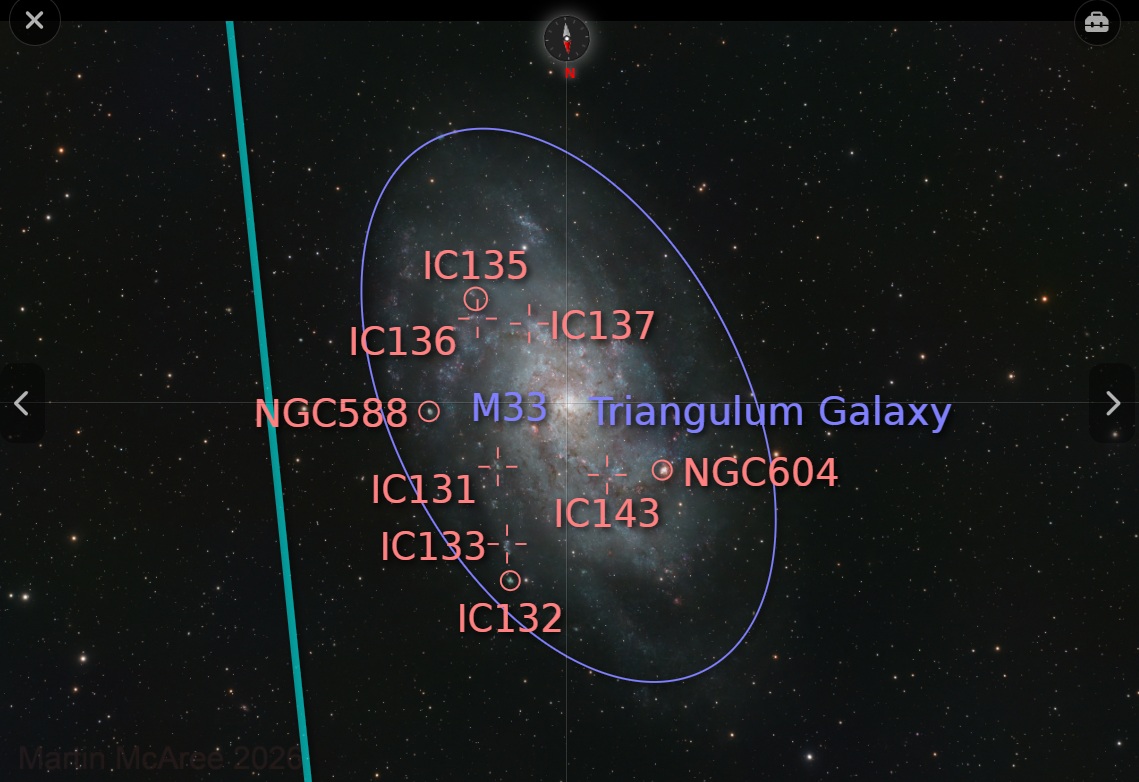
Location Annotated Image
History
M33, also known as the Triangulum Galaxy, has a long history of astronomical observation
and study. It was first recorded by the Italian astronomer Giovanni Battista Hodierna
before 1654, although its diffuse appearance meant that it was not initially recognized
as a galaxy. In 1764, Charles Messier independently observed the object and catalogued
it as M33 in his Catalogue des Nébuleuses et des Amas d'Étoiles. During the nineteenth
century, improved telescopes revealed M33's complex structure and numerous nebular
regions. A major advance came in the early twentieth century, when observations of
variable stars in M33 by astronomers including Edwin Hubble demonstrated that it
lay far beyond the Milky Way, providing important evidence that spiral nebulae were
independent galaxies. Subsequent studies using spectroscopy, radio astronomy, infrared
observations, and space-
Physics
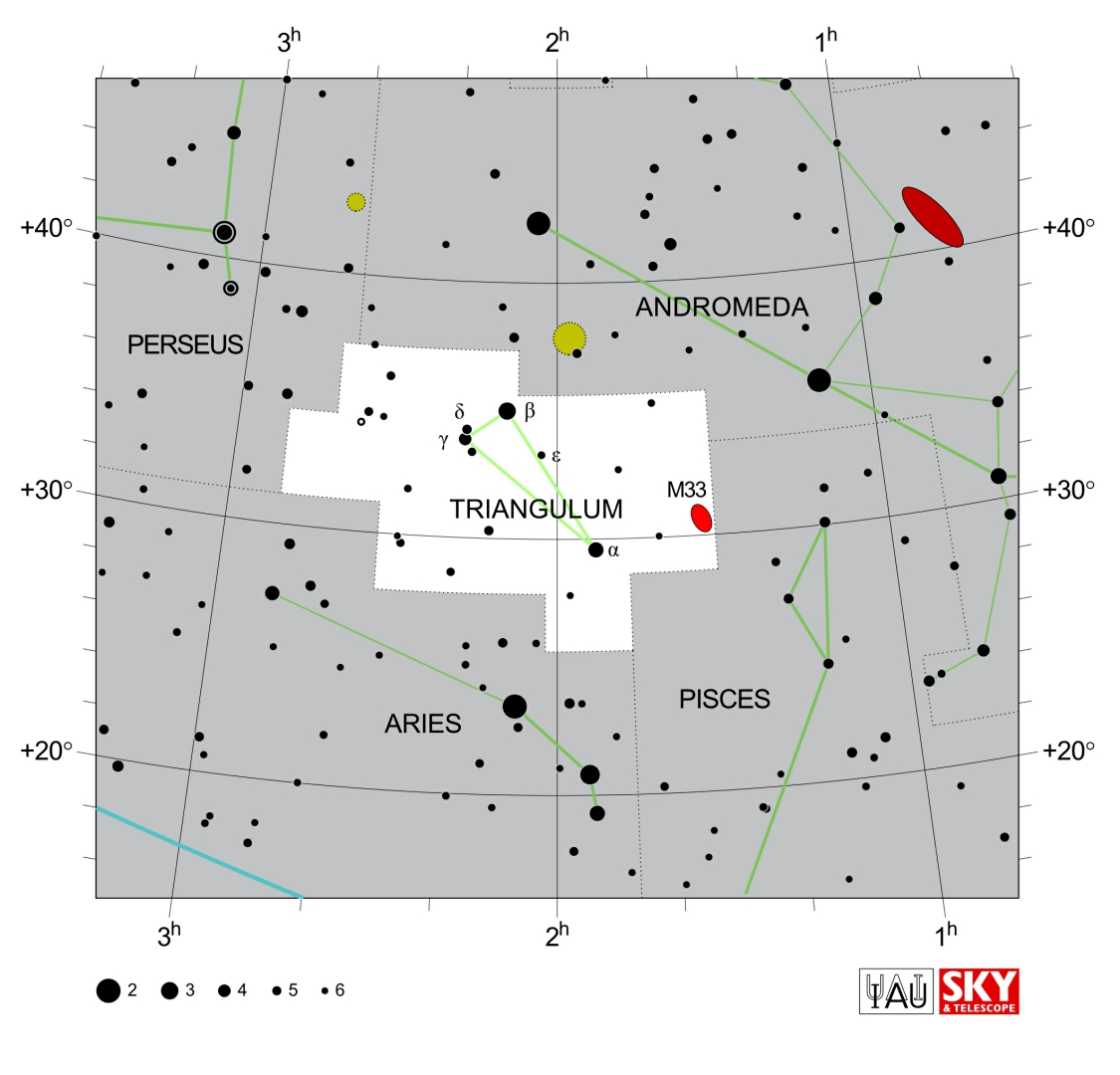
Messier 33, also designated NGC 598, is a spiral galaxy in the constellation Triangulum
and a major member of the Local Group. Charles Messier catalogued it in 1764. Its
proximity allows telescopes to resolve stellar populations and nebulae while also
measuring the structure of an entire galaxy. Consequently, M33 connects the detailed
astrophysics of stars and gas clouds with the broader study of galaxy evolution [1].
This paper is a review of published observations and interpretations, rather than
a report of new measurements. Its central question is how a disk-
Distance and Spatial Scale
Breuval et al. (2023) used Hubble Space Telescope photometry of 154 Cepheid variables to obtain a distance modulus of 24.622 ± 0.030 magnitudes, corresponding to 840 ± 11 kpc [2]. Cepheids are useful distance indicators because their pulsation periods correlate with their luminosities. Once this relation is calibrated, the difference between intrinsic and observed brightness yields a distance after accounting for extinction and other observational effects.
At the adopted distance, one arcsecond corresponds to approximately 4.1 parsecs,
calculated using the small-
Disk Structure and the Interstellar Medium
M33 has a disk-
The neutral atomic hydrogen disk extends well beyond the brightest optical regions.
Corbelli et al. (2014) traced its rotation to approximately 23 kpc and found that
the disk becomes warped beyond about 8 kpc [3]. A warp means that the orientation
of the gas changes with radius, so a single flat-
Different gas phases provide complementary information. Atomic hydrogen is mapped
through its 21-
Star Formation and Stellar Feedback
From extinction-
Star formation is associated with dense molecular material, but a galaxy-
NGC 604 is a particularly prominent example of massive star formation in M33. Webb
observations resolve intricate cavities and filaments in this giant H II region,
whose hot stellar population includes more than 200 O-
Feedback has competing consequences. Heating and gas removal can inhibit further gravitational collapse, whereas compression may help some dense structures collapse. A bright rim or shell alone does not establish that new stars were triggered by feedback: this interpretation requires additional evidence, such as stellar ages and gas motions. NGC 604 is valuable because its spatially resolved structure allows these mechanisms to be examined within their galactic setting.
Rotation and Dark Matter
Corbelli et al. (2014) measured rotation speeds rising to about 100 kilometres per second by a galactocentric radius of 4 kpc, with outer speeds reaching roughly 120–130 kilometres per second [3]. In Newtonian gravity, the observed rotation requires more gravitating matter than the mapped stellar and gaseous components alone provide. This additional contribution is described by a dark matter halo.
A useful order-
An enclosed mass is different from the total halo mass inferred by extending a model beyond the measured rotation curve. Corbelli et al. obtained a halo mass of approximately 4.3 x 10¹¹ solar masses for their preferred Navarro–Frenk–White model [3]. Such an estimate depends on the assumed halo profile and its extrapolation. López Fune et al. showed that conclusions about central cusps and cores also depend on the fitting method: some analyses favour an NFW profile, while another approach permits both NFW and cored Burkert descriptions [8]. M33 therefore supplies strong evidence for a substantial dark component within the standard gravitational framework, while leaving aspects of its detailed distribution uncertain.
The Nucleus and Chemical Enrichment
M33 contains a compact nuclear stellar system without a prominent classical bulge.
Gebhardt et al. (2001) used Hubble imaging and spectroscopy with stellar dynamical
models to place an upper limit of approximately 1,500 solar masses on a central black
hole [7]. This published limit is much smaller than the masses of the supermassive
black holes found in many large galaxies. It should not be interpreted as proof that
M33 contains no black holes anywhere, or that an arbitrarily low-
Spectroscopy also traces the accumulation of elements heavier than helium. Bresolin
et al. (2010), combining planetary nebulae and H II regions, reported a representative
radial gradient in alpha-
The precision of abundance work depends on the diagnostic method. Bresolin (2011)
found smaller intrinsic abundance scatter than some earlier analyses and showed that
particular strong-
M33 in the Local Group
M33 is dynamically associated with the Andromeda system, although the details of
its past orbit remain uncertain. Its warped outer disk motivates investigations of
tidal interactions, but a warp by itself does not identify a unique encounter. Reconstructing
the orbit requires three-
Patel, Besla and Mandel (2017) found support for a first-
References
1. NASA. Messier 33 The Triangulum Galaxy. Hubble Messier Catalog.
2. Breuval, L., et al. (2023). A 1.3% distance to M33 from HST Cepheid photometry. The Astrophysical Journal, 951, 118.
3. Corbelli, E., Thilker, D., Zibetti, S., Giovanardi, C., and Salucci, P. (2014).
Dynamical signatures of a LCDM-
4. Verley, S., Corbelli, E., Giovanardi, C., and Hunt, L. K. (2009). Star formation in M33: multiwavelength signatures across the disk. Astronomy and Astrophysics. Preprint posted 2008.
5. Verley, S., Corbelli, E., Giovanardi, C., and Hunt, L. K. (2010). Star formation in M33: the radial and local relations with the gas. Astronomy and Astrophysics. Preprint posted 2009.
6. ESA/Webb (2024). Webb peers into the tendrils of NGC 604. Observational image release.
7. Gebhardt, K., et al. (2001). M33: A Galaxy with No Supermassive Black Hole. The Astronomical Journal.
8. López Fune, E., Salucci, P., and Corbelli, E. (2017). The radial dependence of dark matter distribution in M33. Monthly Notices of the Royal Astronomical Society. Preprint posted 2016.
9. Bresolin, F., Stasińska, G., Vílchez, J. M., Simon, J. D., and Rosolowsky, E. (2010). Planetary nebulae in M33: probes of AGB nucleosynthesis and ISM abundances. Monthly Notices of the Royal Astronomical Society.
10. Bresolin, F. (2011). The Abundance Scatter in M33 from H II Regions: Is There Any Evidence for Azimuthal Metallicity Variations? The Astrophysical Journal.
11. Patel, E., Besla, G., and Mandel, K. (2017). Orbits of massive satellite galaxies II. Bayesian estimates of the Milky Way and Andromeda masses using high precision astrometry and cosmological simulations. Monthly Notices of the Royal Astronomical Society, 468, 3428.