

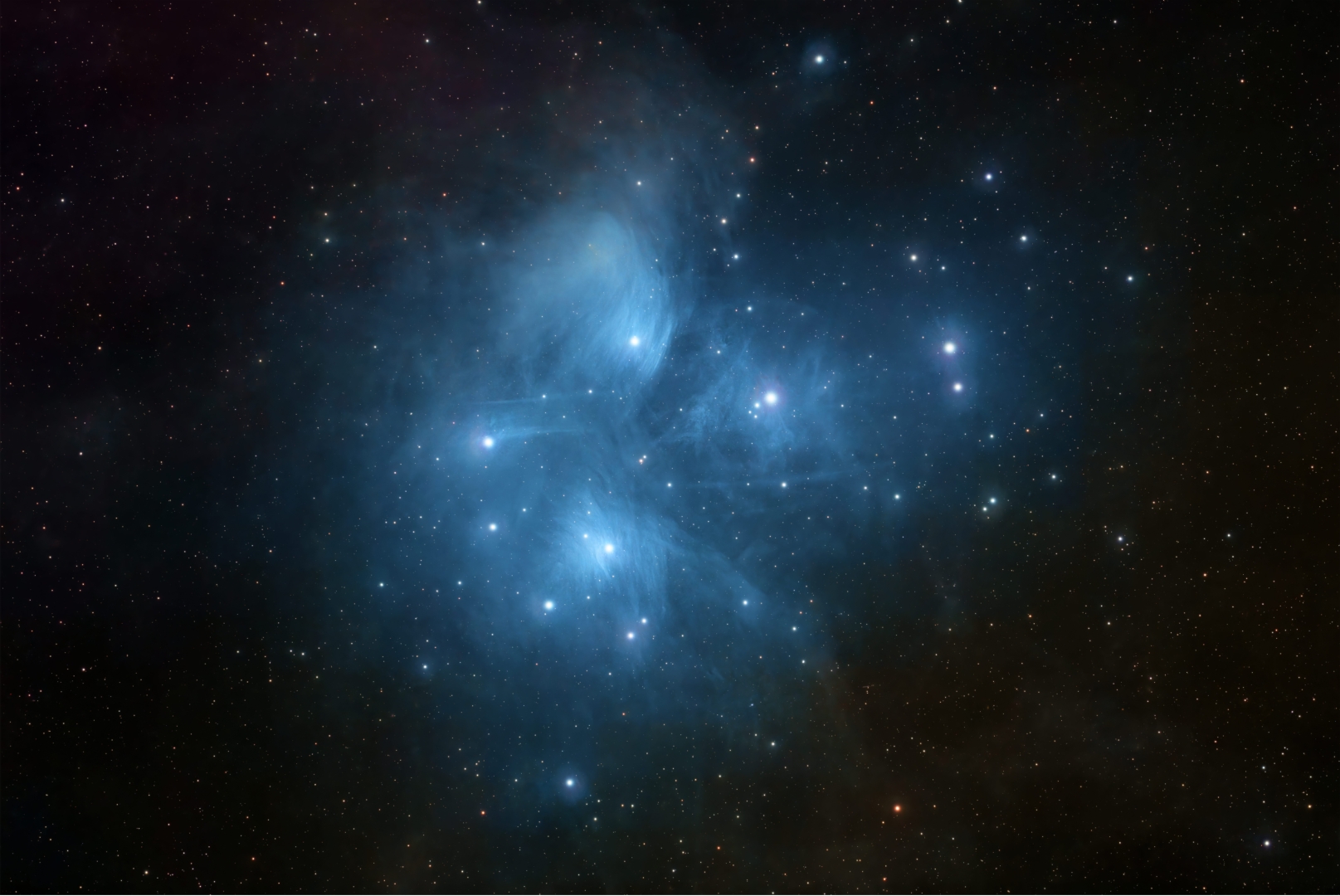
M 45 or The Pleiades.
Object
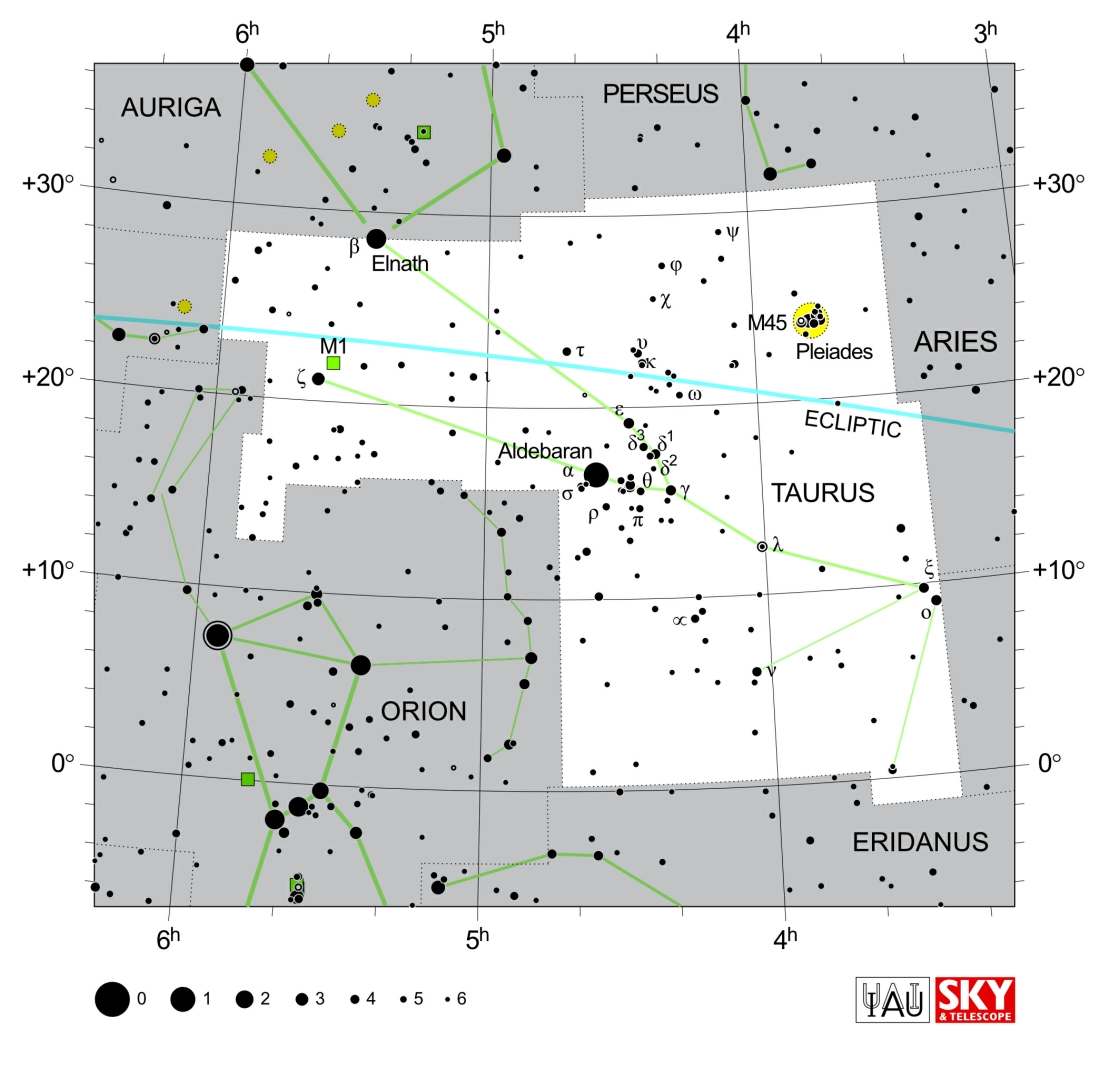
The Pleiades, also known as M45, is one of the most famous open star clusters in
the night sky. Located in the constellation Taurus, it is relatively close to Earth,
at a distance of about 440 light-
The cluster is surrounded by faint reflection nebulosity, caused by dust scattering
the blue light emitted by its hot, young stars. This nebulosity is particularly noticeable
around some of the brighter stars and can be seen clearly in long-
Image
This image was taken on the nights of the 17th and 19th of November 2025. The image was captured with an OSC camera and processed primarily in PixInsight with plugins. The details are as follows:
Location: Cork city, Ireland (Bortle 7).
Date: 17th and 19th of November 2025.
Seeing: Poor to average.
Moon Phase: Waning Crescent 4 to 7%.
Telescope: William Optics GT 81 Mk IV.
Barlow/Reducer: Willaim Optics Flat 6AIII 0.8X Flattener/Reducer.
Coma Corrector: N/A.
Other Optics: N/A.
Camera: ZWO ASi 2600 MC Pro
Filter 1: Optolong L-
Filter 2: Optolong Clear (for capturing RGB stars).
Controller: ZWO ASiair Pro
Guide Scope: William Optics M-
Guide Camera: ZWO Asi 120MM Mini Guide Camera.
Guiding Error: 1.24” to 0.56” RMS.
Mount: Sky Watcher EQ6-
Image Processing:
Application 1: Graxpert.
Application 2: Pleiades Astrophoto PixInsight & Plugins.
Application 3: RC Astro BlurXTerminator.
Application 4: RC Astro StarXTerminator.
Application 5: RC Astro NoiseXTerminator.
Image Capture:
Light Frames: 248 x 30 s.
Flat Frames: 60.
Dark Frames: 30 x 180 s.
Bias Frames: 30.
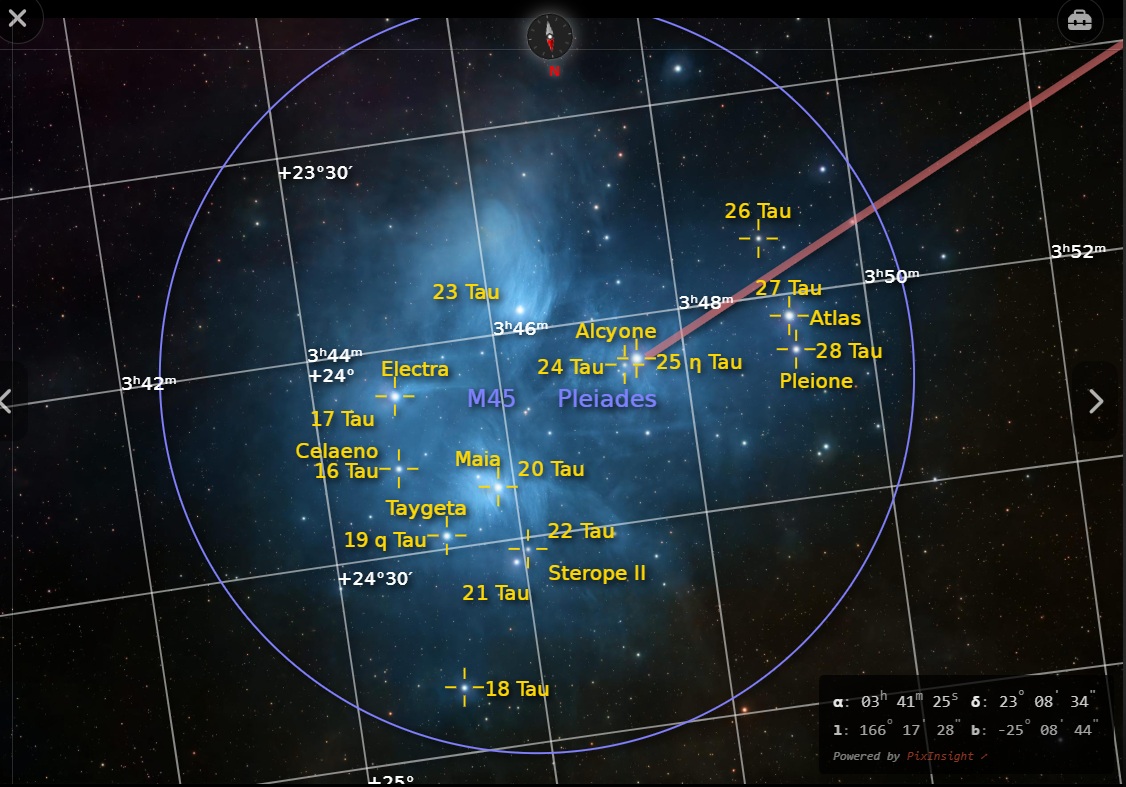
Location Annotated Image
History
The Pleiades are much older as a human astronomical landmark than the name "M45" suggests. The cluster was known to ancient civilizations across the world. One of the earliest known depictions is associated with the Nebra Sky Disc, a Bronze Age artifact from Germany dating to around 1600 BCE. Babylonian astronomers called the group MUL.MUL, roughly meaning "star of stars," and placed it prominently in their stellar traditions. The Pleiades appear in ancient Greek literature, including works associated with Homer and Hesiod. They are also mentioned in the Hebrew Bible, including Amos and Job. Their regular seasonal appearance made them useful for calendars, agriculture, navigation and religious traditions.
The Greek story — the Seven Sisters: The name Pleiades comes from Greek mythology. The seven principal sisters were:
- Alcyone
- Maia
- Electra
- Merope
- Taygete
- Celaeno
- Sterope (Asterope)
They were said to be the daughters of Atlas and Pleione.
According to one version of the myth, the sisters were pursued by Orion, the hunter. Zeus transformed them into stars to protect them, which is why the constellation of Orion appears to chase the Pleiades across the sky. Interestingly, most people see only six stars easily with the naked eye rather than seven. This led to stories in several cultures about a "lost" or hidden seventh sister. The Pleiades had obviously been visible for thousands of years, but the telescope revealed that what looked like a handful of stars was actually a much larger group. In 1610, Galileo Galilei pointed his telescope at the Pleiades and recorded 36 stars in a sketch published in Sidereus Nuncius ("The Starry Messenger"). This was an important change in perspective: the Pleiades weren't simply seven bright points arranged in the sky. There were many more stars hidden from unaided vision.
Charles Messier was an 18th-
In 1767, English astronomer John Michell made an interesting argument: the probability of so many bright stars appearing close together purely by chance was extremely small. He suggested that groups such as the Pleiades were probably physically connected. Later measurements of the stars' motions confirmed that the stars really do travel together through space. Modern astronomy now understands M45 as a genuine open cluster: its stars formed together from the same enormous cloud of gas and dust.
Today we know that M45 contains over 1,000 stars, dominated visually by young, hot
blue-
Physics
The Pleiades is one of the most conspicuous and culturally significant stellar groupings
in the night sky. Located in the northwestern region of Taurus, it can be observed
without optical assistance as a compact collection of approximately six or seven
bright stars. Telescopic and astrometric observations reveal that these luminous
stars constitute only the visible core of a much larger population containing hundreds—and
potentially more than one thousand—probable members. M45 is classified as an open
cluster: a gravitationally associated population of stars formed from the same molecular
cloud and possessing approximately the same age and initial chemical composition.
Open clusters are especially valuable in astrophysics because differences among their
member stars primarily reflect stellar mass rather than age or initial composition.
The Pleiades is particularly important because it is both nearby and young, allowing
astronomers to study stars during their early main-
Historical Observations
The Pleiades has been recognized since antiquity and appears in the astronomical
traditions of numerous civilizations. References to the cluster occur in ancient
Greek literature, including the works of Homer and Hesiod, and comparable traditions
are found in Mesopotamian, Chinese, Indigenous American, and other cultures. Its
recurring appearance in seasonal skies made it useful for agriculture, navigation,
and calendrical measurement. Galileo Galilei made one of the earliest telescopic
studies of the cluster. In Sidereus Nuncius, published in 1610, he illustrated numerous
stars surrounding the naked-
Distance, Age and Composition.
Modern measurements generally place the Pleiades at approximately 136 parsecs, equivalent
to about 444 light-
Age estimates depend upon the method and stellar models employed. Main-
The cluster has a chemical composition broadly comparable to that of the Sun. Because its stars originated in the same molecular cloud, they share similar initial abundances. Minor differences reported among individual stars may arise from measurement uncertainties, atmospheric effects, rotation, diffusion, or localized chemical peculiarities rather than major variations in the material from which the cluster formed.
Stellar Population
The visual appearance of M45 is dominated by hot, luminous B-
Because the cluster contains stars of nearly identical age but different masses,
it provides a powerful test of stellar-
Rotation and Magnetic Activity
Stellar rotation is one of the most extensively studied properties of the Pleiades.
Young stars generally rotate more rapidly than older stars because they have not
yet lost substantial angular momentum through magnetized stellar winds. Pleiades
members exhibit a broad range of rotational periods, particularly among lower-
Reflection Nebulosity
Long-
The dust was once interpreted as surviving material from the molecular cloud in which the cluster formed. However, the Pleiades is sufficiently old that most of its natal gas and dust should already have been dispersed. Modern observations instead indicate that the cluster is passing through an unrelated or only indirectly associated interstellar dust cloud. The observed filaments have therefore been shaped by the relative movement of the stars, gas, and dust. ESA/Hubble observations report that the cloud moves relative to the cluster at approximately 11 kilometres per second.
Structure and Dynamical Evolution
The Pleiades possesses a dense central region surrounded by a more diffuse population
extending over several degrees of the sky. Its apparent diameter therefore depends
upon the membership criteria and limiting magnitude employed. The cluster’s total
stellar mass is estimated to be several hundred solar masses, although different
surveys produce different values because faint stars, binaries, and widely separated
members are difficult to identify conclusively. The spatial distribution of the cluster
exhibits evidence of mass segregation: massive stars are preferentially concentrated
near its central regions, while lower-
Like other open clusters, the Pleiades is not expected to remain gravitationally
bound indefinitely. Interactions among its members, encounters with molecular clouds,
and the tidal gravitational field of the Milky Way gradually remove stars from the
cluster. Studies based on Gaia astrometry have identified extended stellar structures
and possible tidal tails associated with M45, indicating that the cluster may be
undergoing an early stage of dynamical disruption. Some analyses have traced Pleiades-
Scientific Significance
M45 functions as a benchmark cluster in several major areas of astrophysics. Its
known distance and relatively uniform age make its color–magnitude diagram an important
test of theoretical stellar isochrones. Comparisons between observed and predicted
stellar luminosities, temperatures, and colors help refine models of pre-
Planetary research has further increased the scientific value of the Pleiades. Searches for infrared excesses around its stars provide evidence of debris disks produced by collisions among planetesimals. Because the cluster is approximately 120 million years old, its planetary systems represent an intermediate evolutionary stage between young protoplanetary disks and mature systems such as the Solar System. Observations of these stars can therefore constrain the timescales of planet formation, orbital evolution, and atmospheric loss.
References
Alfonso, J., García-
European Space Agency. “Gaia: ESA’s billion-
Li, Y., Pang, X., & Tang, S.-
Melis, C., Reid, M. J., Mioduszewski, A. J., Stauffer, J. R., & Bower, G. C. (2014).
“A VLBI resolution of the Pleiades distance controversy.” Science, 345, 1029–1032.
Harvard-
NASA. “Messier 45: The Pleiades.” NASA Science
Stauffer, J. R., Schultz, G., & Kirkpatrick, J. D. (1998). “Keck spectroscopy of
Pleiades brown-