Sh 2-157 The Lobster Nebula
Object
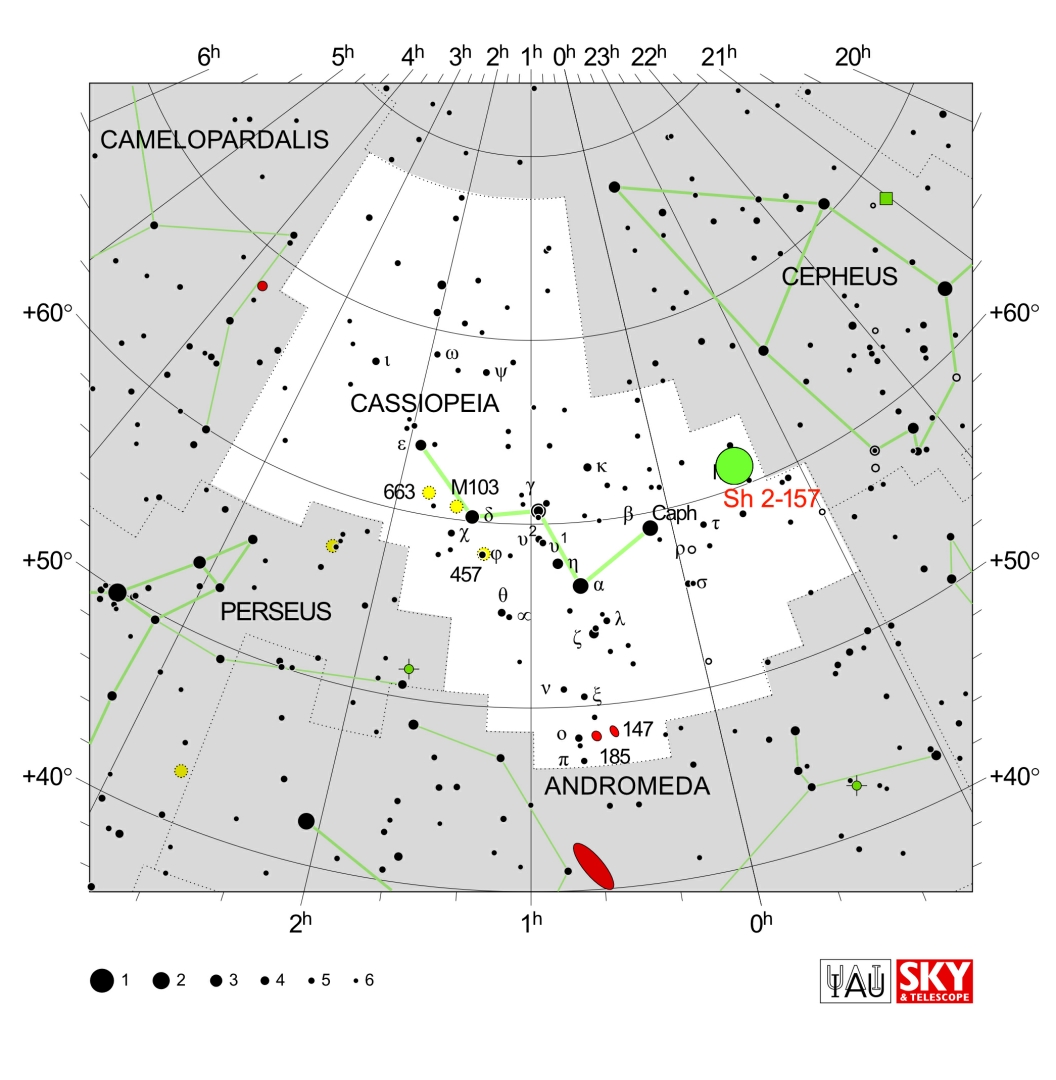
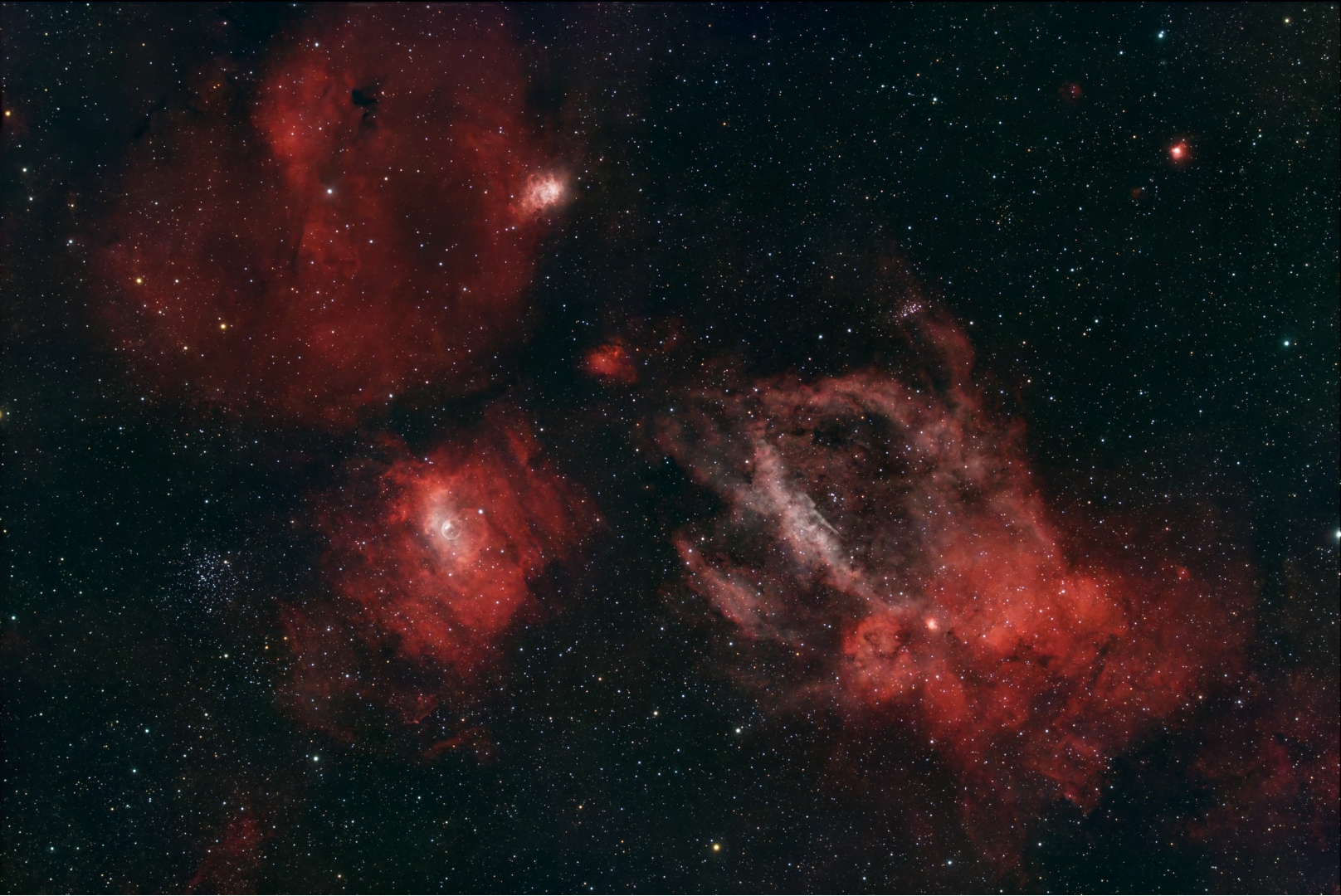
The Lobster Claw Nebula, also known as Sharpless 2-157, is a large emission nebula
and active star-forming region located in the constellations of Cassiopeia and Cepheus.
It lies in the Perseus Arm of the Milky Way at a distance of roughly 8,000–11,000
light-years from Earth. The nebula's popular name comes from its distinctive shape,
which resembles the open pincers of a lobster's claw. It is an H II region - a vast
cloud of ionized hydrogen gas that glows because photoionisation and recombination
due to intense ultraviolet radiation from nearby young, massive stars. Strong stellar
winds from these stars have sculpted the gas into arcs, cavities, filaments, and
bubble-like structures.
Image
Location: Cork city, Ireland (Bortle 7).
Date: 25h and 27th December 2025.
Seeing: Poor to average.
Moon Phase: Waxing Crescent, 35-37%.
Telescope: William Optics GT 81 Mk IV.
Barlow/Reducer: Willaim Optics Flat 6AIII 0.8X Flattener/Reducer.
Coma Corrector: N/A.
Other Optics: N/A.
Camera: ZWO ASi 2600 MC Pro
Filter 1: Optolong L-Ultimate dual band narrowband filter (3 nm).
Filter 2: Optolong Clear (for capturing RGB stars).
Controller: ZWO ASiair Pro
Guide Scope: William Optics M-G50WGIII 50 mm Guide Scope.
Guide Camera: ZWO Asi 120MM Mini Guide Camera.
Guiding Error: 1.24” to 0.56” RMS.
Mount: Sky Watcher EQ6-R Pro.
Image Processing:
Application 1: Graxpert.
Application 2: Pleiades Astrophoto PixInsight & Plugins.
Application 3: RC Astro BlurXTerminator.
Application 4: RC Astro StarXTerminator.
Application 5: RC Astro NoiseXTerminator.
Image Capture:
Light Frames: 56 x 180 s.
Flat Frames: 60.
Dark Frames: 30 x 180 s.
Bias Frames: 30.
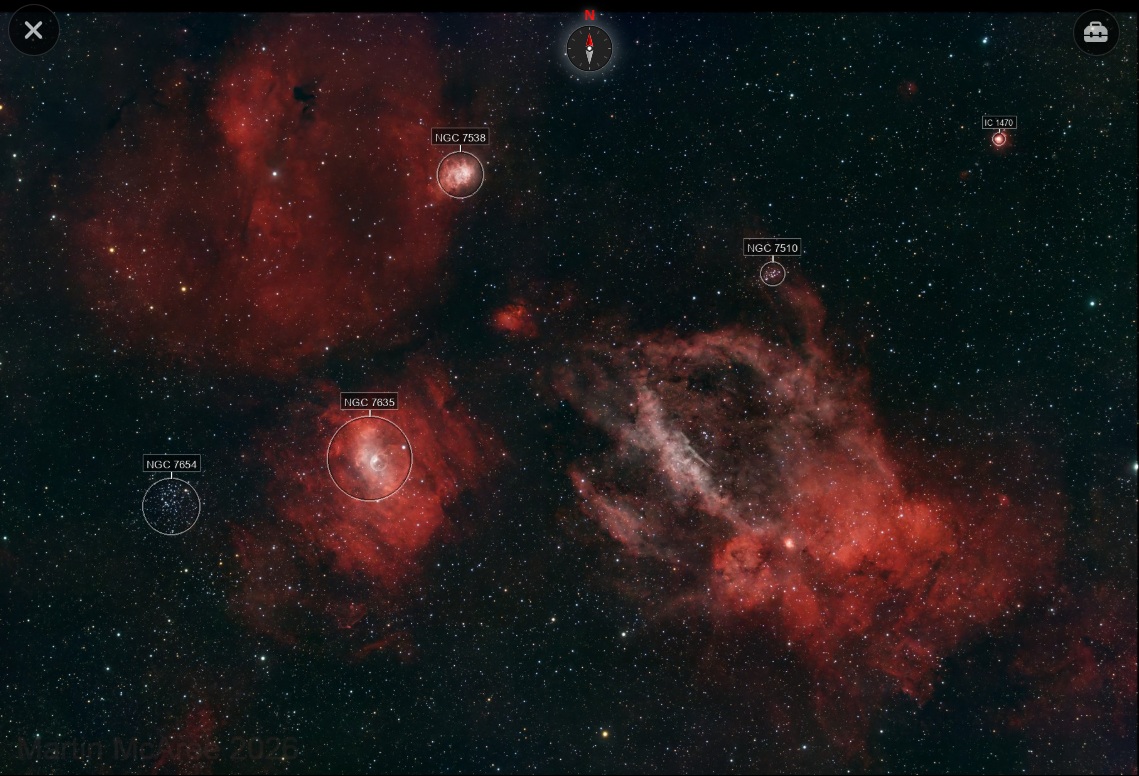
Location Annotated
Image
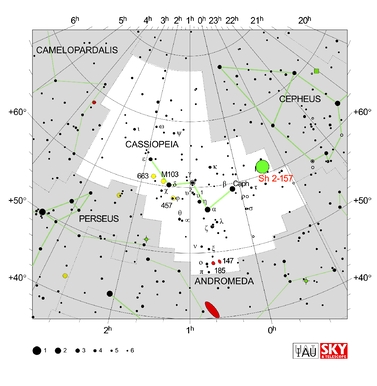
History
The nebula was first systematically catalogued by American astronomer Stewart Sharpless
in his influential 1959 catalog of H II regions, where it received the designation
Sh 2-157. The Sharpless Catalog contained 313 emission nebulae and became one of
the standard references for studying ionized hydrogen clouds in the Milky Way. Some
portions of the nebula had been observed earlier in photographic sky surveys, but
Sharpless's work established it as a distinct H II region. The bright circular sub-region
surrounding the Wolf–Rayet star WR 157 was catalogued separately as Sh 2-157A.
Physics
Sh 2-157 is a galactic H II region located within the Perseus Arm of the Milky Way.
Often referred to as the Lobster Claw Nebula because of its distinctive morphology,
it represents an important laboratory for studying massive star formation and the
interaction between young stars and the interstellar medium. The following reviews
the physical characteristics of Sh 2-157, its stellar population, and the processes
responsible for its observed structure and evolution. H II regions are clouds of
ionized hydrogen illuminated by ultraviolet radiation from young, massive stars.
These nebulae provide valuable insights into the formation and evolution of stellar
clusters and the dynamics of the interstellar medium. Sh 2-157, cataloged in the
Sharpless Catalogue of H II Regions, is among the most active star-forming regions
in the Cassiopeia–Cepheus complex. The nebula contains multiple compact H II regions,
embedded protostars, dense molecular cores, and young stellar clusters, making it
an excellent target for multiwavelength investigations.
Location and Physical Characteristics
Sh 2-157 is situated in the Perseus spiral arm at a distance of approximately 3.4
kiloparsecs from the Sun. The nebula is embedded within a giant molecular cloud complex
and exhibits a highly structured morphology consisting of ionized gas, dust lanes,
and compact regions of ongoing star formation. Observations reveal two principal
components, designated Sh 2-157A and Sh 2-157B. Sh 2-157A contains the optically
visible H II region, while Sh 2-157B is a more deeply embedded compact H II region
associated with young stellar objects. The nebula's characteristic claw-like appearance
results from the combined effects of stellar winds, ionization fronts, and density
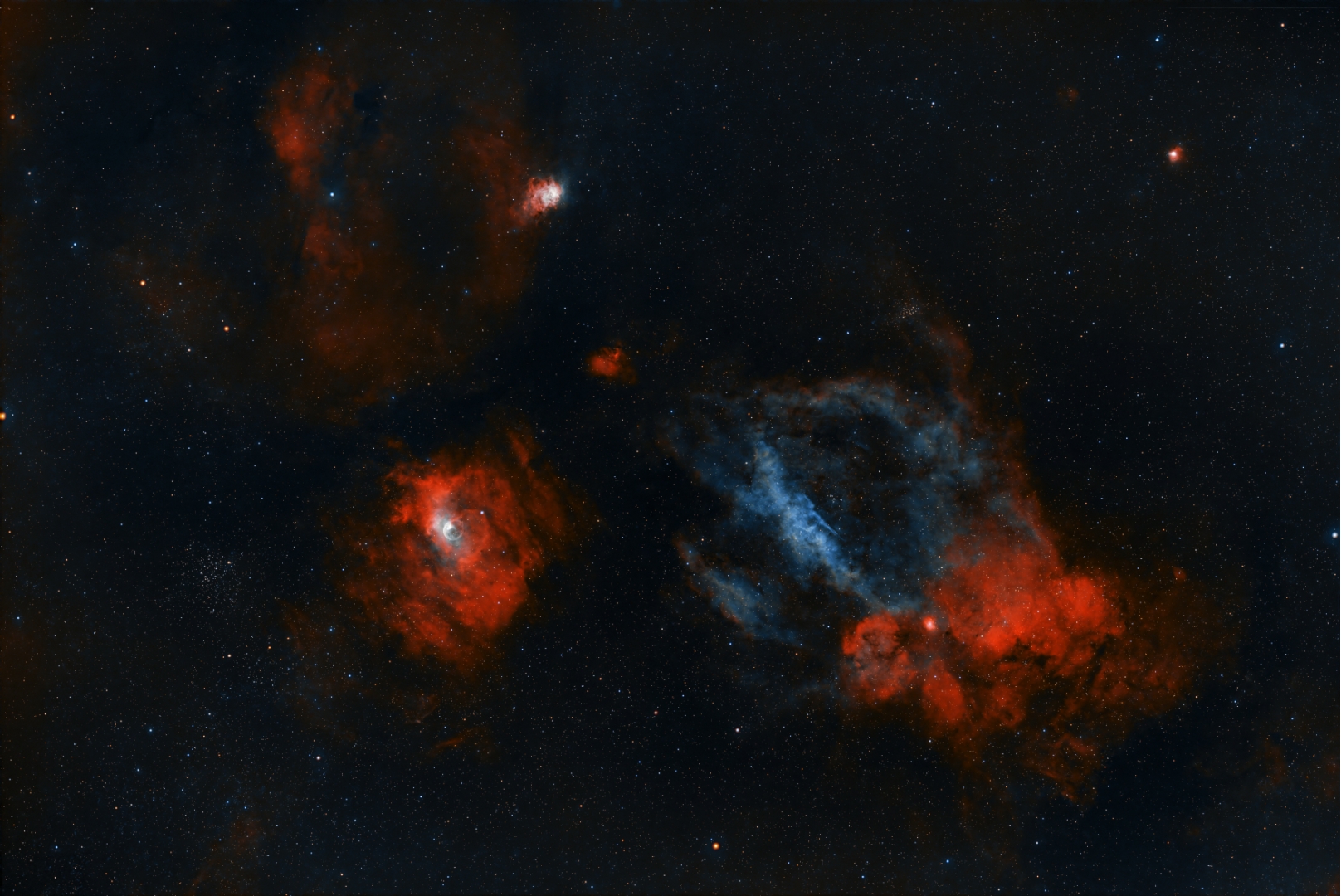
variations within the surrounding molecular cloud. Narrowband imaging shows extensive
hydrogen-alpha emission together with regions enriched in doubly ionized oxygen (O
III).
Stellar Population
A prominent feature of the region is the young open cluster Markarian 50, which hosts
several massive stars. The cluster contains the Wolf-Rayet star WR 157 (HD 219460),
one of the principal sources of ionizing radiation in the nebula. Wolf-Rayet stars
are evolved, massive stars characterized by strong stellar winds and substantial
mass loss. The energetic radiation and winds from WR 157 contribute significantly
to shaping the surrounding gas and dust. Near-infrared observations have identified
numerous young stellar objects, protostars, and stars exhibiting infrared excesses,
indicating the presence of circumstellar disks and ongoing stellar formation. These
observations suggest that star formation in Sh 2-157 has occurred over multiple generations
rather than as a single burst.
Star Formation Activity
Sh 2-157 is recognized as a site of active massive star formation. Molecular-line
observations reveal dense cores, water masers, and molecular outflows associated
with newly forming stars. Several compact condensations within the cloud have been
identified as candidate prestellar or starless cores, representing the earliest stages
of future star formation. High-resolution millimeter observations demonstrate the
coexistence of evolved H II regions, embedded protostars, and dense starless condensations
within a relatively small volume. This mixture of evolutionary stages provides evidence
that star formation in the nebula is ongoing and sequential. The feedback from massive
stars may trigger additional star formation by compressing nearby molecular gas through
radiation driven implosion (RDI) inducing gravitational collapse.
Interaction Between Stars and the Interstellar Medium
The morphology of Sh 2-157 reflects the interaction between massive stars and their
natal molecular environment. Ultraviolet radiation ionizes surrounding hydrogen,
producing the bright emission characteristic of H II regions as a result of subsequent
recombination. Stellar winds from massive stars create cavities, shells, and ring-like
structures within the nebula. These processes alter the density distribution of the
gas and influence subsequent star formation. The northern region of the nebula contains
a ring-shaped structure associated with WR 157, while embedded clusters and compact
H II regions occupy denser portions of the molecular cloud. Such structures illustrate
the complex feedback mechanisms operating within giant star-forming complexes.
Scientific Significance
Sh 2-157 serves as an important example of clustered massive star formation. Its
combination of evolved massive stars, young stellar objects, ultracompact H II regions,
and dense molecular condensations allows us to investigate multiple phases of stellar
evolution simultaneously. Multiwavelength observations spanning radio, infrared,
optical, and millimeter wavelengths have made the nebula a valuable laboratory for
testing theories of cluster formation and feedback-driven star formation.
Summary
The Sh 2-157 Nebula is a dynamic and complex star-forming region within the Perseus
Arm of the Milky Way. Its rich stellar population, including the Wolf-Rayet star
WR 157 and the young cluster Markarian 50, drives the ionization and structural evolution
of the surrounding gas. Ongoing star formation, evidenced by protostars, molecular
outflows, and dense prestellar cores, demonstrates that the region remains astrophysically
active. Continued observations of Sh2-157 provide important insights into the formation
of massive stars, the evolution of stellar clusters, and the interaction between
stars and the interstellar medium.
References
Baume, G., Vázquez, R. A., & Carraro, G. (2004). Photometric studies of Markarian
50.
Chen, C.-C., Williams, J. P., & Pandian, J. D. (2012). H II Regions, Embedded Protostars,
and Starless Cores in Sharpless 2-157.
Sharpless, S. (1959). A Catalogue of H II Regions.
van der Hucht, K. A. (2001). The VIIth Catalogue of Galactic Wolf-Rayet Stars.
Williams, J. P., et al. Studies of massive star formation in Sh 2-157.
Resources
HII Regions, Embedded Prorostars, and Starless Cores in Sharpless 2-157. Chen et
al, 2012.
Abstract: We present arcsecond resolution 1.4mm observations of the high mass star
forming region, Sharpless 2-157, that reveal the cool dust associated with the first
stages of star formation. These data are compared with archival images at optical,
infrared, and radio wavelengths, and complemented with new arcsecond resolution mid-infrared
data. We identify a dusty young HII region, numerous infrared sources within the
cluster envelope, and four starless condensations. Three of the cores lie in a line
to the south of the cluster peak, but the most massive one is right at the center
and associated with a jumble of bright radio and infrared sources. This presents
an interesting juxtaposition of high and low mass star formation within the same
cluster which we compare with similar observations of other high mass star forming
regions and discuss in the context of cluster formation theory.
Link to Paper
Near-Infrared Imaging of the Star-Forming Regions of Sh 2-157 and Sh 2-152. Chen
et al, 2009.
Abstract: Near-infrared JHK and H2 v = 1–0 S (1) imaging observations of the star-forming
regions Sh2-157 and Sh2-152 are presented. The data reveal a cluster of young stars
associated with H2 line emission in each region. Additionally, many IR point sources
are found in the dense core of each molecular cloud. Most of these sources exhibit
infrared color excesses typical of T Tauri stars, Herbig Ae/Be stars, and protostars.
Several display the characteristics of massive stars. We calculate histograms of
the K-magnitude and [H − K] color for all sources, as well as two-color and color–magnitude
diagrams. The stellar populations inside and outside the clusters are similar, suggesting
that these systems are rather evolved. Shock-driven H2 emission knots are also detected,
which may be related to evident subclusters in an earlier evolutionary stage.
Link to Paper